Follow us on:


Corporate Case Study | June 2026
In December 2015, three former Flipkart engineers founded a company in Bengaluru with a bet that India’s cash-heavy, fragmented payments economy would eventually move to a single interoperable digital rail. The Unified Payments Interface that they were building for had not even launched yet. Nine months later, PhonePe went live on UPI in August 2016. Two months after that, the Government of India announced demonetization, overnight invalidating 86% of all cash in circulation. The tailwind that followed was unlike anything in the history of Indian fintech. A decade later, PhonePe has 600 million registered users, processes over 330 million transactions daily, commands a 47% share of all UPI transactions in India, has reported Rs 7,115 crore in revenue in FY25, and has filed a draft red herring prospectus targeting a $1.5 billion IPO at a valuation of approximately $14.5 to $15 billion. This is the story of how three engineers, a government policy shock, and a Walmart acquisition shaped the most consequential payments company in India’s history.
Rs 7,115 Cr
Revenue from operations in FY25, up 40.5% from Rs 5,064 crore in FY24. Payment services accounted for 88.55% of operating revenue. Adjusted PAT (excluding ESOP costs) was Rs 630 crore in FY25.
$14.5 Billion
Valuation at which General Atlantic invested $600 million in October 2025. The updated DRHP filed January 2026 targets a $1.5 billion IPO at a $14.5 to $15 billion valuation. Walmart holds 71.77% of the company.
47%+
PhonePe’s share of all UPI transactions by volume as of mid-2025, per NPCI data. The company processed 864.7 crore transactions in March 2025 alone, with a transaction value of Rs 12.57 lakh crore in that month.
600 Million
Registered users as of April 2025, up from 435 million in January 2023. The merchant acceptance network covers over 40 million merchants. Annualised Total Payment Value exceeds Rs 150 lakh crore.
Table of Contents
- Part I: The Founders and the Origin Story Three Flipkart alumni, the Mime360 acquisition, and the bet on UPI before UPI existed
- Part II: The Flipkart Acquisition and the UPI Launch (2016) Acquired for ~$20 million, live on UPI in August 2016, and then demonetization
- Part III: Demonetization and the Growth Years (2016 to 2020) How overnight cash invalidation created PhonePe’s most important growth event
- Part IV: The Walmart Era and the Spinoff (2018 to 2022) Walmart’s Flipkart acquisition, PhonePe’s partial and full separation, the $700 million raise
- Part V: The Reverse Flip and the Rs 8,000 Crore Tax Moving domicile from Singapore to India in December 2022 and what it cost
- Part VI: The Funding Story Every major round from inception through the $600 million General Atlantic investment of 2025
- Part VII: Financial Performance FY19 to FY25 Revenue growth, loss trajectory, adjusted profitability, and the cost structure
- Part VIII: The Product Portfolio Beyond Payments Insurance, lending, wealth, Pincode, Indus Appstore, and Share.Market
- Part IX: UPI Market Share and the 30% Cap Risk NPCI’s regulatory cap, why it was deferred, and what it means for PhonePe’s dominance
- Part X: The IPO DRHP details, shareholding, offer structure, valuation, and what the public markets will evaluate
- Part XI: Business Model and Revenue Breakdown
- Part XII: Assessment and What Comes Next
Part IThe Founders and the Origin Story
Three Engineers, Two Decades of Friendship
PhonePe was founded in December 2015 by Sameer Nigam, Rahul Chari, and Burzin Engineer. The three co-founders have known each other for close to two decades. Sameer Nigam and Rahul Chari studied together at the University of Mumbai in the 1990s, where they became close friends and roommates. Nigam and Burzin Engineer met in Los Angeles as they were beginning their careers in software engineering.
Sameer Nigam holds a Bachelor’s degree in Computer Engineering from the University of Mumbai, a Master’s in Computer Science from the University of Arizona, and an MBA in Entrepreneurship from the Wharton School at the University of Pennsylvania. He worked as Director of Search Product Development at Shopzilla from 2001 to 2007. Rahul Chari holds a Bachelor’s degree in Computer Engineering from the University of Mumbai, where he was a gold medalist, and a Master’s in Computer Science from Purdue University. Burzin Engineer holds a Master’s in Computer Science from the University of Southern California and has held engineering leadership roles at multiple US technology companies including M-GO.
Mime360: The Startup That Brought Them to Flipkart
In 2009, the three reunited and co-founded Mime360, a digital media distribution platform designed to connect content owners with distributors and consumers. In 2011, Flipkart acquired Mime360. This brought Nigam, Chari, and Engineer into the Flipkart ecosystem. Nigam served as Senior Vice President of Engineering and later Vice President of Marketing at Flipkart. Chari worked on building scalable technology platforms for Flipkart’s payments and commerce infrastructure. Engineer held senior engineering leadership roles within the Flipkart group.
Their four years at Flipkart gave the founders a detailed, operational understanding of the problem they would go on to solve. Flipkart, as India’s largest e-commerce company in 2015, processed millions of transactions daily. The payment experience was deeply fragmented: net banking with its bank-specific interfaces, debit and credit cards that failed frequently on mobile networks, and cash on delivery that accounted for over 60% of orders because nothing digital was reliable enough or accessible enough to displace it. The founders saw the gap not just as a product problem but as an infrastructure problem. India needed a universal, interoperable payments layer that was not controlled by any single bank or payment network.
The name: PhonePe was named to evoke the Hindi phrase meaning “on the phone,” a deliberate signal of mass accessibility. The founders’ intent from day one was to build a product for every Indian, not just the urban, banked, English-speaking consumer that most fintech products implicitly targeted. This positioning would prove commercially decisive.
Sameer Nigam (CEO)
EducationB.E. Mumbai; MS Arizona; MBA Wharton
Masters degreeMS Computer Science, Univ. of Arizona
Prior employerFlipkart (SVP Engineering, VP Marketing)
Prior startupMime360 (acquired by Flipkart, 2011)
Current stake2.55% (per DRHP January 2026)
Rahul Chari (CTO) & Burzin Engineer (CRO)
Rahul Chari educationB.E. Mumbai (Gold Medal); MS Purdue
Burzin Engineer educationMS Computer Science, USC
Prior employer (both)Flipkart and Mime360
Rahul Chari stake2.55% (per DRHP January 2026)
Part IIThe Flipkart Acquisition and the UPI Launch (2016)
Acquired Before the App Launched
PhonePe was incorporated in December 2015. In April 2016, before the app had even publicly launched, Flipkart acquired PhonePe for approximately $20 million. This was a strategic integration play rather than a financial acquisition: Flipkart wanted to own its payment infrastructure rather than depend on third-party payment gateways. By bringing PhonePe in-house, Flipkart could integrate it as the default payment method across its 100 million-plus user base, giving PhonePe instant distribution that would have taken years to build organically.
The timing of the Flipkart acquisition coincided with one of the most significant developments in Indian financial infrastructure history. The National Payments Corporation of India (NPCI) launched the Unified Payments Interface in August 2016, creating a real-time, interoperable payments system that allowed any UPI-enabled app to send money from and to any bank account in India without requiring the sender and receiver to be on the same platform. No single company owned UPI. Any entity could build an app on top of it. The infrastructure problem that had long frustrated Indian digital payments was, in principle, solved.
PhonePe launched its UPI-based app in August 2016, making it one of the first non-bank entities to go live on the UPI platform. The app supported over 11 Indian languages from an early stage, which was a deliberate choice to address the population of Hindi and regional language speakers who formed the majority of India’s consumer base but had been systematically excluded from digital financial services because those services were built in English.
The Demonetization Windfall: November 2016
On November 8, 2016, the Government of India announced that Rs 500 and Rs 1,000 banknotes, which constituted approximately 86% of all currency in circulation by value, would cease to be legal tender at midnight. The policy triggered immediate, intense demand for any functional digital payment mechanism. Bank branches and ATMs ran out of cash within days. The public, forced to transact without physical currency, turned in large numbers to whatever digital options existed. PhonePe, having launched just three months earlier on the new UPI rails, was positioned at exactly the right place at the right moment.
The demonetization effect: PhonePe had been growing steadily in the months after its August 2016 launch, benefiting from Flipkart’s distribution. Demonetization accelerated this growth dramatically. The platform saw hundreds of thousands of new users registering daily in the weeks following the announcement. Crucially, these were not just urban, smartphone-savvy consumers. The cash shortage affected every segment of the Indian economy, forcing even reluctant adopters to try digital payments. PhonePe’s multilingual interface and simple UPI-based flow lowered the adoption barrier enough to convert a significant share of these forced converts into habitual users.
Part IIIThe Growth Years (2017 to 2020)
Cashback, Merchants, and the Kirana Penetration Strategy
Between 2017 and 2020, PhonePe’s growth strategy had two parallel tracks. The first was aggressive consumer acquisition through cashback and incentive programmes. In FY19, PhonePe spent over Rs 950 crore on rewards for customers to use the platform. These were not promotional gimmicks: they were the price of building habitual payment behaviour in a population that had never before used digital payments and needed sufficient incentive to try something unfamiliar. The cashback strategy worked. By the end of FY20, PhonePe had built a user base that was using the platform not just because they were paid to, but because the habit had formed.
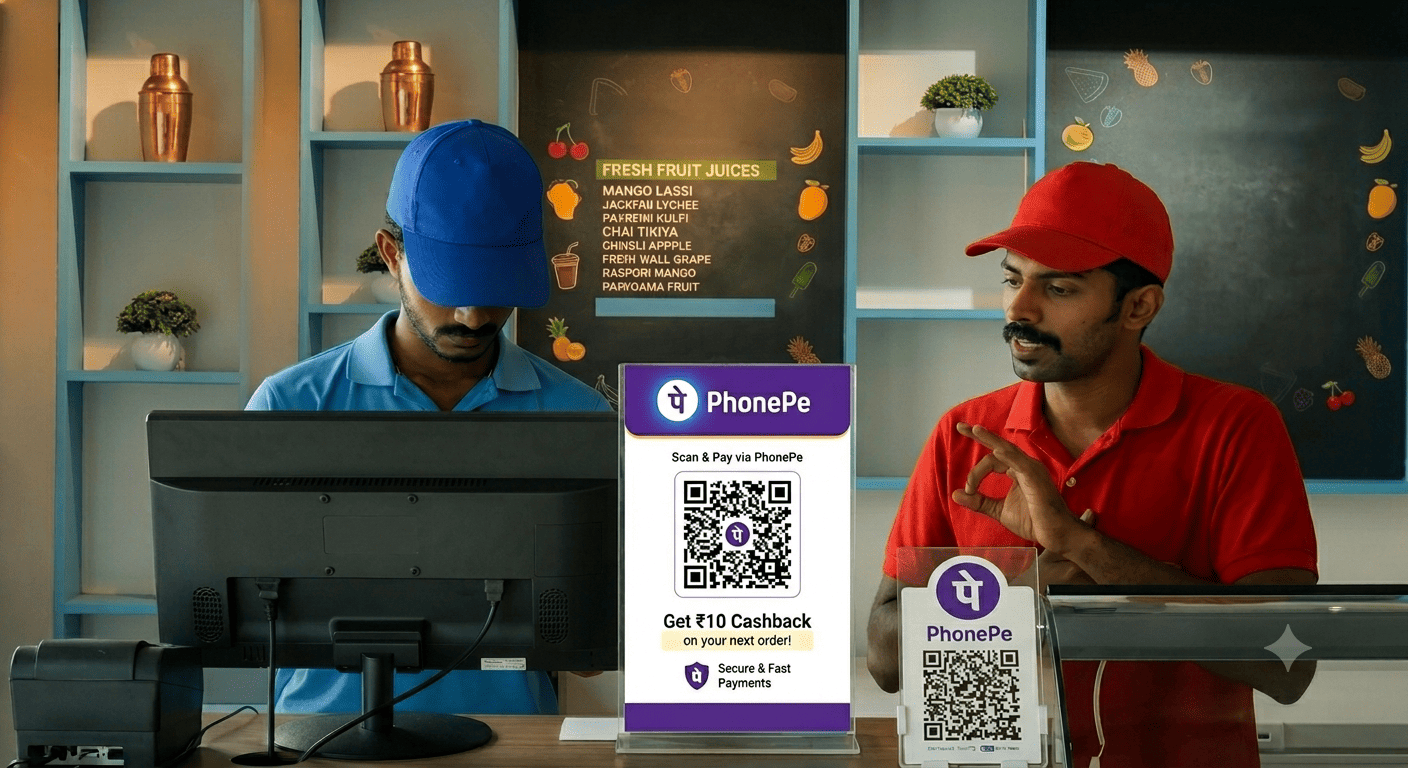
The second track was merchant acquisition, particularly at kirana stores and offline retail. PhonePe deployed QR codes aggressively, enabling any shopkeeper with a smartphone to accept UPI payments without any hardware investment. The merchant network, which reached 3.5 crore (35 million) merchants by January 2023, was the critical moat that digital payment competitors found difficult to replicate quickly. A consumer using PhonePe for online payments stays on PhonePe because it works offline too. The ubiquity of the QR code in neighbourhood stores reinforced the app’s daily utility.
By FY20, PhonePe had grown revenue to Rs 427 crore from Rs 245 crore in FY19, a 74% year-on-year increase. Net losses in FY20 were Rs 1,771 crore, the first year in which losses declined year-on-year. The business was still far from profitable, but the direction was correct: revenue was growing faster than expenses, and the loss-per-rupee-of-revenue was declining.
FY21: Revenue Rs 690 Crore, Losses Decline 44%
In FY21, PhonePe reported a revenue increase of 85% to Rs 690 crore from Rs 372 crore in FY20 on a standalone basis. More significantly, operational losses excluding ESOP costs fell 44% to Rs 888 crore from Rs 1,570 crore in FY20. This was the first clear evidence of operating leverage: the cost of acquiring and retaining a transaction was falling as the platform scaled. The cashback spend that had been necessary to build habits was reducing as those habits became self-sustaining. In FY24, cashback and incentive spend had declined to just over Rs 15 crore from Rs 950 crore in FY19, a reduction of over 98%.
Part IVThe Walmart Era and the Spinoff (2018 to 2022)
Walmart Acquires Flipkart: PhonePe Becomes a Walmart Asset
In May 2018, Walmart acquired a controlling stake in Flipkart for approximately $16 billion, the largest e-commerce acquisition in history at the time. The deal gave Walmart ownership of PhonePe as part of the Flipkart group. Walmart’s strategic rationale included gaining access to India’s rapidly growing digital payments infrastructure through PhonePe, a business that it saw as a standalone opportunity beyond its role as Flipkart’s payment processor.
In December 2020, PhonePe underwent a partial separation from Flipkart. A number of Flipkart shareholders, led by Walmart, acquired shares directly in PhonePe, creating a structure where PhonePe had its own cap table separate from Flipkart’s. The partial separation valued PhonePe at $5.5 billion. PhonePe simultaneously raised $700 million in primary capital from existing Flipkart investors including Tiger Global. The partial separation was the first step in what would eventually become a full separation: Flipkart and PhonePe now had independent shareholder bases and independent growth paths, though both remained under Walmart’s majority ownership.
The full separation from the Flipkart Group was completed in December 2022. Flipkart subsequently launched its own competing UPI app, Super.Money, which has grown to become one of the top five UPI players in India, creating a notable situation in which Walmart now owns equity positions in two competing UPI platforms.
Walmart’s position as of the January 2026 DRHP: Walmart’s holding entity, WM Digital Commerce Holdings, owns 71.77% of PhonePe. In the OFS component of the upcoming IPO, Walmart plans to sell approximately 4.59 crore shares, reducing its stake by roughly 9.06 percentage points. Tiger Global and Microsoft are selling their entire holdings (0.2% and 0.71% respectively) through the same OFS. No fresh capital is being raised; the IPO is entirely an offer for sale by existing shareholders.
Part VThe Reverse Flip and the Rs 8,000 Crore Tax
Singapore to India: A Rs 8,000 Crore Decision
PhonePe, like many Indian startups, had initially flipped its holding structure to Singapore in 2016, following its acquisition by Flipkart and the standard practice of holding Indian operating companies through a Singapore entity for tax efficiency and easier access to international capital. In October 2022, PhonePe announced its reverse flip: moving its domicile from Singapore back to India. The change was completed in December 2022.
The cost of the reverse flip was extraordinary. The redomiciling triggered approximately Rs 8,000 crore (roughly $943 million) in capital gains tax to the Indian government, arising from the structure in which PhonePe investors sold their shares in the Singapore entity and reinvested in the Indian entity. Walmart, as the majority shareholder, paid the largest portion of this tax bill. The company confirmed that Walmart and other investors covered the full tax liability. A PhonePe spokesperson described it at the time as the “right long-term strategy,” a formulation that is easier to defend now that the company is preparing for a domestic IPO that would have been structurally impossible while domiciled in Singapore.
Why It Was Worth It
The reverse flip logic was threefold. First, Indian regulations for digital payments companies were tightening, and regulatory compliance is substantially simpler for an India-domiciled entity than for a foreign holding company operating in India. Second, PhonePe’s entire business is India-focused. The company has no material revenues from markets outside India and has no near-term plan to expand internationally. Holding the company through Singapore created administrative complexity with no corresponding benefit. Third, and most practically, listing on Indian stock exchanges requires the issuer to be domiciled in India. PhonePe’s IPO ambition made the reverse flip not optional but necessary.
The Rs 8,000 crore tax, while large in absolute terms, is modest relative to the enterprise value unlocked. At a $15 billion IPO valuation, the tax represented approximately 5.5% of enterprise value. For Walmart, which paid the majority of the bill, it was the cost of positioning its largest single fintech asset for a domestic public listing in India’s deepest capital market.
Part VIThe Funding Story
PhonePe’s funding history is inseparable from its ownership history. The company did not go through the typical Series A, B, C venture capital progression. Instead, it was acquired before it launched, became a subsidiary of one of India’s largest e-commerce companies, was then acquired by the world’s largest retailer, and eventually raised independent institutional capital only after becoming a standalone entity.
-
2016April 2016Flipkart Acquisition (~$20 million)
Flipkart acquired PhonePe for approximately $20 million before the app launched, integrating it as the default payment option across the Flipkart platform. This gave PhonePe distribution to 100 million-plus users instantly.
-
2018May 2018Walmart Acquires Flipkart ($16 billion)
Walmart’s acquisition of a controlling stake in Flipkart for approximately $16 billion made PhonePe a Walmart-owned asset. PhonePe was valued implicitly as part of the Flipkart group transaction.
-
2020December 2020Partial Spinoff at $5.5 Billion; $700 Million Raised
PhonePe partially separated from Flipkart. Flipkart shareholders led by Walmart acquired shares directly in PhonePe, establishing a standalone cap table. The company simultaneously raised $700 million in primary capital from existing investors including Tiger Global. Valuation: $5.5 billion.
-
2023January 2023General Atlantic Leads $350 Million at $12 Billion Valuation
PhonePe raised $350 million from General Atlantic as the first tranche of a larger round, at a pre-money valuation of $12 billion. This was the first external institutional round after the Flipkart/Walmart ownership period. General Atlantic invested an additional $100 million in May 2023 within the same round.
-
2023May 2023Round Extended: Total Reaches $850 Million at $12.5 Billion
The 2023 funding round was extended to $850 million total, with Walmart, Ribbit Capital, Tiger Global, and General Atlantic all participating. The post-money valuation settled at $12.5 billion, making PhonePe India’s most valuable fintech company at the time.
-
2025October 2025General Atlantic Invests $600 Million at $14.5 Billion Valuation
General Atlantic made a $600 million investment in PhonePe, its largest single-company bet in India, surpassing its $870 million investment in Reliance Jio Platforms in 2020. The round valued PhonePe at $14.5 billion, a 16% premium to the 2023 valuation. Total fundraising across four major rounds reached approximately $1.6 billion in primary capital since separation from Flipkart.
Shareholding (DRHP January 2026)
Walmart (WM Digital Commerce Holdings)71.77%
General Atlantic Singapore8.98%
Headstand Pte Ltd5.73%
3State Ventures1.03%
Sameer Nigam (Co-founder)2.55%
Rahul Chari (Co-founder)2.55%
Tiger Global0.20% (selling via OFS)
Microsoft0.71% (selling via OFS)
Valuation Milestones
April 2016 (Flipkart acq.)~$20M (deal value)
December 2020 (partial spinoff)$5.5 Billion
January 2023 (GA round)$12 Billion (pre-money)
May 2023 (extended round)$12.5 Billion
October 2025 (GA reinvestment)$14.5 Billion
IPO target valuation$14.5–$15 Billion
Part VIIFinancial Performance: FY19 to FY25
Revenue: From Rs 245 Crore to Rs 7,115 Crore in Six Years
PhonePe’s revenue trajectory from FY19 to FY25 is one of the fastest-growing in Indian fintech history. Revenue from operations grew from Rs 245 crore in FY19 to Rs 7,115 crore in FY25, a 29-fold increase in six years. The compound annual growth rate over this period was approximately 75%. The growth reflects both the expansion of UPI as an infrastructure and PhonePe’s ability to convert its dominant market share into monetised transaction volume through payment service charges, platform fees, subscription fees from devices like smart speakers, and advertising fees.
PhonePe: Revenue from Operations (Rs Crore)
Sources: Company RoC filings. FY19-FY21 standalone figures; FY22 onward consolidated.
The Loss Trajectory and the Path to Adjusted Profitability
PhonePe has reported net losses in every financial year since inception. This is not unusual for a platform business investing heavily in growth, but the magnitude and trajectory of the losses require careful interpretation. The headline net loss figure is dominated by ESOP (Employee Stock Option Plan) costs, which are non-cash accounting charges that reflect the value of stock options granted to employees. These are real economic obligations but do not represent cash leaving the business.
| FY | Revenue (Rs Cr) | Net Loss (Rs Cr) | Adjusted PAT (excl. ESOP) | YoY Revenue Growth |
|---|---|---|---|---|
| FY19 | 245 | Large loss | – | – |
| FY20 | 427 | Rs 1,771 Cr | – | +74% |
| FY21 | 690 | Rs 1,728 Cr | – | +85% (standalone) |
| FY22 | 1,646 | Rs 2,014 Cr | Rs -455 Cr (adj.) | +138% |
| FY23 | 2,914 | Rs 2,795 Cr | Rs +159 Cr (adj.) | +77% |
| FY24 | 5,064 | Rs 1,996 Cr | Rs +197 Cr (adj.) | +73.8% |
| FY25 | 7,115 | Rs 1,727 Cr | Rs +630 Cr (adj.) | +40.5% |
Understanding the adjusted PAT figures: PhonePe reports two profitability metrics alongside its statutory net loss. The “Adjusted PAT excluding ESOP costs” removes the non-cash ESOP expense from the net loss to show what the underlying business economics look like. This metric turned positive in FY23 at Rs 159 crore and grew to Rs 630 crore in FY25. The “Adjusted EBITDA excluding ESOP costs” further removes finance costs and depreciation, reaching Rs 1,477 crore in FY25. The statutory net loss in FY25 of Rs 1,727 crore is largely driven by the ESOP expense, which is real but non-cash. The payments business standalone turned adjusted PAT positive at Rs 710 crore in FY24, confirming that the core business is economically sound.
FY25 Cost Structure
In FY25, total expenditure was Rs 9,394 crore. The largest cost item was employee benefit expenses at Rs 4,097 crore, constituting approximately 44% of total expenses. This is the line that contains the large ESOP charges. Payment processing charges, which are fees paid to the UPI ecosystem and acquiring banks for processing transactions, were the second largest cost at Rs 1,688 crore. Advertising and sales promotion expenses fell 21.6% to Rs 542 crore in FY25, continuing the multi-year trend of declining cashback spend as the user base became self-sustaining. Other costs including IT, licensing, customer support, legal, and logistics made up the remainder.
Accumulated losses: By the end of FY25, PhonePe’s accumulated net losses since inception reached Rs 14,860 crore. This is the total net loss booked over the company’s lifetime and is largely a product of the ESOP charges from the corporate restructuring in FY23 (which involved substantial ESOP grants as one-time restructuring rewards) and the earlier years of cashback-funded growth. The accumulated deficit does not impair the business’s current operational capacity, which has been adjusted-PAT positive since FY23 and generating Rs 1,477 crore in adjusted EBITDA in FY25.
Part VIIIThe Product Portfolio Beyond Payments
PhonePe’s stated vision is to become a financial superapp: a single platform through which every Indian can access not just payments but the full range of financial services and adjacent commerce experiences. The core payments app remains the dominant revenue driver at approximately 88.5% of operating revenue in FY25. The non-payments businesses collectively grew 208% year-on-year in FY25 from a small base, indicating the early stages of meaningful diversification.
UPI Payments are the foundation: person-to-person money transfers, person-to-merchant payments, and bill payments via UPI. PhonePe was one of the first non-bank entities live on UPI and has maintained a 46 to 48% market share by volume since 2022.
PhonePe for Business is the merchant-facing product. Merchants accept QR code payments, use PhonePe’s soundbox devices (which announce payment confirmations audibly), and access business analytics. Over 40 million merchants use PhonePe as of April 2025.
Online Payment Aggregator is a newer regulated business for which PhonePe received final RBI approval in September 2025. This allows PhonePe to onboard online merchants, facilitating e-commerce payments, and directly competes with Razorpay, PayU, and CCAvenue in the payment gateway market. This licence significantly expands PhonePe’s total addressable market beyond UPI person-to-person and offline merchant payments.
Smart Speakers are voice-notification devices deployed at merchant counters, reaching 4.1 million units by August 2023. They generate subscription fee revenue and deepen the merchant relationship by making PhonePe hardware-present at point of sale.
PhonePe for Business is the merchant-facing product. Merchants accept QR code payments, use PhonePe’s soundbox devices (which announce payment confirmations audibly), and access business analytics. Over 40 million merchants use PhonePe as of April 2025.
Online Payment Aggregator is a newer regulated business for which PhonePe received final RBI approval in September 2025. This allows PhonePe to onboard online merchants, facilitating e-commerce payments, and directly competes with Razorpay, PayU, and CCAvenue in the payment gateway market. This licence significantly expands PhonePe’s total addressable market beyond UPI person-to-person and offline merchant payments.
Smart Speakers are voice-notification devices deployed at merchant counters, reaching 4.1 million units by August 2023. They generate subscription fee revenue and deepen the merchant relationship by making PhonePe hardware-present at point of sale.
PhonePe Insurance distributes insurance products in partnership with insurance companies. Products available include health insurance, life insurance, motor insurance, and device protection. Insurance and lending together generated Rs 557.6 crore in FY25 revenue, up 208% from Rs 181.1 crore in FY24. This was the fastest-growing revenue segment in FY25 and is expected to be a key diversification driver in the IPO narrative.
The insurance distribution model leverages PhonePe’s existing user relationship and payment trust to offer relevant policies at the point of financial activity. A user completing a travel booking on PhonePe is immediately prompted with travel insurance options. The zero-CAC (customer acquisition cost) advantage of distributing within an existing high-frequency app is the core commercial logic of this business.
The insurance distribution model leverages PhonePe’s existing user relationship and payment trust to offer relevant policies at the point of financial activity. A user completing a travel booking on PhonePe is immediately prompted with travel insurance options. The zero-CAC (customer acquisition cost) advantage of distributing within an existing high-frequency app is the core commercial logic of this business.
Lending covers PhonePe’s credit distribution products, including personal loans and buy-now-pay-later offered in partnership with regulated non-bank financial companies (NBFCs) and banks. PhonePe acts as a distribution platform rather than a lender, taking referral fees while the credit risk sits with partner institutions. This capital-light model avoids the balance sheet risk of direct lending while capturing the distribution economics.
Lending has been a significant growth area across Indian fintechs in 2023 and 2024, with the Reserve Bank of India tightening regulatory norms for digital lending in late 2023. PhonePe’s partnership model, which routes loan disbursals through regulated entities, keeps it within the revised regulatory framework.
Lending has been a significant growth area across Indian fintechs in 2023 and 2024, with the Reserve Bank of India tightening regulatory norms for digital lending in late 2023. PhonePe’s partnership model, which routes loan disbursals through regulated entities, keeps it within the revised regulatory framework.
Share.Market is PhonePe’s stockbroking and investment platform, branded as a wealth and investment product catering to investors and traders of all expertise levels. It offers equity trading, mutual fund investments, and other investment products through a SEBI-registered broker entity under the PhonePe group. The stockbroking business targets retail investors who are already comfortable with the PhonePe app for payments, lowering the adoption barrier for first-time equity investors.
Mutual fund distribution is also available within the PhonePe app, allowing users to invest in mutual funds through a direct-plan distribution model. This is a zero-commission product for users, with revenue coming from the platform fee or asset management company arrangements.
Mutual fund distribution is also available within the PhonePe app, allowing users to invest in mutual funds through a direct-plan distribution model. This is a zero-commission product for users, with revenue coming from the platform fee or asset management company arrangements.
Pincode is PhonePe’s hyperlocal e-commerce platform, described as a local commerce app that connects consumers with neighbourhood stores, kirana shops, and supermarkets. Pincode was initially built on the Open Network for Digital Commerce (ONDC) protocol and launched in April 2023. It later paused non-food ONDC deliveries due to weak demand and logistics issues, and pivoted to focus on quick commerce and local grocery delivery with significant investment injected in late 2024.
Pincode is a strategic bet on local retail commerce rather than a competing general e-commerce platform. The fact that Walmart simultaneously owns Flipkart (a horizontal e-commerce marketplace) and has invested in Pincode (a local commerce platform) reflects a portfolio approach to Indian digital commerce rather than a single-channel strategy.
Pincode is a strategic bet on local retail commerce rather than a competing general e-commerce platform. The fact that Walmart simultaneously owns Flipkart (a horizontal e-commerce marketplace) and has invested in Pincode (a local commerce platform) reflects a portfolio approach to Indian digital commerce rather than a single-channel strategy.
Indus Appstore was launched publicly on February 21, 2024. It is a native Android-based mobile app store designed for India’s digital ecosystem. It supports discovery of over 2 lakh apps in 12 Indian languages and is positioned as an alternative to Google Play for the Indian market. No listing fees were charged to developers for the first year (until April 2025). Developers are free to use any third-party payment gateway, unlike Google Play’s mandatory Google payment processing.
Indus Appstore addresses the regulatory and commercial tension between large global app store operators and Indian developers, and positions PhonePe as an infrastructure company for India’s digital ecosystem rather than just a payments company. The commercial model is early-stage, but the strategic logic reflects PhonePe’s long-term ambition to be a platform company rather than a single-product fintech.
Indus Appstore addresses the regulatory and commercial tension between large global app store operators and Indian developers, and positions PhonePe as an infrastructure company for India’s digital ecosystem rather than just a payments company. The commercial model is early-stage, but the strategic logic reflects PhonePe’s long-term ambition to be a platform company rather than a single-product fintech.
Part IXUPI Market Share and the 30% Cap Risk
How PhonePe Built a 47% Share
PhonePe’s 47% share of UPI transactions is not accidental. It is the product of three sequential competitive advantages that compounded over time. The first was timing: PhonePe was one of the first apps live on UPI in August 2016, giving it a months-long head start over competitors in building user familiarity with UPI-based payments. The second was distribution: the Flipkart integration gave PhonePe instant access to 100 million-plus e-commerce users who were already transacting digitally and were receptive to trying a UPI payment method. The third was merchant penetration: PhonePe’s aggressive offline QR deployment, particularly in tier-2 and tier-3 cities and at kirana stores, made its payment acceptance network the most geographically comprehensive of any UPI app.
PhonePe processed 864.7 crore (8.647 billion) transactions in March 2025, accounting for 47.25% of total UPI transactions in that month. The transaction value of those payments was Rs 12.57 lakh crore. The annualised total payment value across all of PhonePe’s platforms exceeds Rs 150 lakh crore as of April 2025. Google Pay is the second-largest UPI app at approximately 34 to 36% market share. Paytm holds approximately 6 to 7%. No other app has more than 3%.
The NPCI 30% Market Cap: The Sword Over PhonePe’s Market Share
In 2020, the National Payments Corporation of India proposed a cap limiting any single third-party UPI application to 30% of total UPI transaction volume. If enforced, this cap would require PhonePe to stop onboarding new users and throttle its growth until its market share declined from 47% to below 30%, a reduction that would take years and would require its competitors to grow substantially. The NPCI has repeatedly deferred enforcement of this cap. The deadline was most recently deferred to December 2026.
The 30% cap risk in concrete terms: If NPCI enforces the 30% cap in December 2026, PhonePe would need to reduce its transaction volume share by approximately 17 percentage points from the current approximately 47%. This would mean stopping new user acquisition, potentially declining merchant activations, and watching its market share erode toward 30% over a multi-year period. The cap would also benefit Google Pay and Paytm disproportionately, as the two companies best positioned to absorb displaced PhonePe volume. PhonePe’s IPO DRHP identifies this regulatory risk explicitly. Investors evaluating the IPO must assess their confidence that the cap will be deferred again, modified, or dropped, versus the probability of enforcement.
The NPCI’s repeated deferrals suggest discomfort with enforcing a rule that would penalise market leadership achieved through product quality and consumer preference. However, the cap has not been formally withdrawn, and each deferral creates uncertainty. The resolution of this regulatory question is, arguably, the single most important binary risk facing PhonePe as a public company.
Part XThe IPO
DRHP Filing and Structure
PhonePe filed its confidential draft red herring prospectus with SEBI for a domestic IPO in September 2025. An updated DRHP was filed on January 21, 2026. The structure of the IPO is an Offer for Sale (OFS) only: no fresh capital is being raised. All proceeds go to selling shareholders. The total OFS size is up to 5.06 crore equity shares. Walmart’s holding entity plans to sell approximately 4.59 crore shares, or roughly 9.06% of its current equity. Tiger Global and Microsoft are divesting their entire holdings through smaller tranches.
The company appointed Kotak Mahindra Capital Company, Citigroup, JPMorgan Chase, and Morgan Stanley as merchant bankers. The IPO is expected to raise approximately Rs 12,000 crore (approximately $1.5 billion) at a valuation of $14.5 to $15 billion. This would make PhonePe one of the largest IPOs in Indian history and the largest pure-fintech listing on Indian exchanges.
PhonePe IPO: Key Details (as per DRHP January 2026)
Company NamePhonePe Limited (converted from Private Limited, April 2025)
Offer TypeOffer for Sale (OFS) only; no fresh issue
OFS SizeUp to 5.06 crore equity shares
Expected IPO Size~Rs 12,000 crore (~$1.5 billion)
Target Valuation$14.5 billion to $15 billion
Listing ExchangeBSE and NSE (Indian exchanges)
BankersKotak Mahindra Capital, Citi, JPMorgan, Morgan Stanley
Largest SellerWalmart (WM Digital Commerce Holdings) — selling ~9% of its 71.77% stake
Founders SellingNo. Nigam and Chari retain 2.55% each and are not selling in the OFS
OFS Proceeds ToSelling shareholders (company receives nothing from OFS)
FY25 RevenueRs 7,115 crore (operating); Rs 7,631 crore (total including other income)
FY25 Net LossRs 1,727 crore (statutory); Adjusted PAT positive Rs 630 crore
What Investors Are Valuing
At a $15 billion valuation, PhonePe would be priced at approximately 21x FY25 revenue. For context, this is in line with or modestly above where mature fintech payment companies trade globally, reflecting the premium attached to PhonePe’s near-monopoly position on India’s UPI infrastructure. Investors buying at this valuation are pricing in continued strong revenue growth (the 40% FY25 growth sustaining at 25 to 30% for several years), margin expansion as ESOP charges normalise and operating leverage continues, successful monetisation of the non-payments businesses (insurance, lending, wealth), and the assumption that the NPCI 30% cap is not enforced.
Part XIBusiness Model and Revenue Breakdown
How PhonePe Makes Money
PhonePe’s revenue model has four components within its payments business and a growing fifth component from financial services and consumer tech. The payment services revenue stream, which contributed Rs 6,300 crore or 88.55% of operating revenue in FY25, breaks down into transaction processing fees (charges to merchants and billers for processing bill payments, digital gold purchases, travel bookings, and other non-P2P transactions), platform fees (charges for using the application including charges on payment devices), subscription fees (monthly charges for smart speaker and other payment device deployments), and advertising fees (charges to financial services and other advertisers for in-app placement).
Critically, person-to-person UPI money transfers are free for consumers and generate no direct fee revenue for PhonePe. The government’s MDR (Merchant Discount Rate) policy for UPI means that basic UPI payments also attract zero MDR. Revenue is generated only where there is a service layer above the basic UPI infrastructure: bill payments, insurance distribution, lending referral fees, stockbroking commissions, and device subscription fees.
Approximately 10% of PhonePe’s revenues in FY24 came from government subsidies, specifically incentives from the Reserve Bank of India provided to banks and digital payment companies to support the digital payments sector. PhonePe disclosed this in its FY24 annual report. This is a meaningful portion of revenue that is, by definition, policy-dependent: if the government reduces or eliminates digital payments subsidies, PhonePe’s revenue would take a direct hit.
The subsidy reflects the government’s recognition that UPI infrastructure is a public good and that the economics of running it need to be supported until commercial monetisation reaches sufficient scale. Whether the subsidy will continue, be reduced, or be replaced by an MDR framework as UPI matures is an open question that PhonePe management and its IPO investors must address.
PhonePe’s 47% UPI market share is protected by two interlocking network effects. On the consumer side, users stay on PhonePe because it is accepted everywhere: the 40 million merchants who display a PhonePe QR code reinforce the payment habit of the 600 million registered users. On the merchant side, merchants accept PhonePe because their customers use it: accepting a platform used by almost half of all UPI payers is not optional for any serious merchant.
These network effects create stickiness that goes beyond product quality or pricing. Even if a competitor builds a technically superior app, persuading 300 million users to switch simultaneously while also persuading 20 million merchants to display the new QR code requires a coordination problem that no individual actor can solve through product improvement alone. This is why Google Pay, with the substantial resources of Alphabet behind it, has not been able to close the gap with PhonePe despite years of trying.
The core constraint in PhonePe’s revenue model is that UPI payments do not generate fee revenue. The government’s decision to mandate zero MDR for UPI transactions means that the most common transaction type on the platform, person-to-person money transfer, generates nothing. PhonePe processes hundreds of millions of these transactions daily at zero direct revenue. The cost of processing them, including payment processing charges, infrastructure, and customer support, is real.
This is why the diversification into insurance, lending, wealth management, and commerce is not just an aspiration but a strategic necessity. The payment volume is the distribution channel; the financial services products are the revenue. In FY25, non-payments revenue (insurance, lending, and other services) grew 208% to approximately Rs 800 crore. If this growth rate continues, financial services will constitute a materially larger share of PhonePe’s revenue within three years, and the company’s revenue quality will improve significantly because financial services revenues tend to carry better margins than payment processing fees.
Part XIIAssessment and What Comes Next
What PhonePe Built in Nine Years
From three engineers in Bengaluru in December 2015 to a company that processes nearly half of all digital payments in India is a decade of compounding advantages. The founders identified the right infrastructure bet before UPI launched. The Flipkart acquisition gave them distribution that money could not buy. Demonetization gave them a consumer adoption shock that competitors needed years to replicate. The aggressive QR code deployment and cashback strategy built habits that proved permanent. And the Walmart ownership gave them the capital depth to sustain heavy losses through a decade of growth investing without the existential funding pressure that constrained smaller competitors.
The financial trajectory is clear: revenue has grown at roughly 75% CAGR since FY19, the business has reached adjusted PAT profitability at Rs 630 crore in FY25, and the cost discipline is evident in the 21.6% reduction in advertising spend and the continued decline in cashback outlays. The non-payments businesses grew 208% in FY25, signalling that the diversification strategy is working, albeit from a small base.
The Three Questions That Will Define the Next Five Years
First, will the NPCI 30% market cap be enforced? If yes, PhonePe’s market position will be permanently impaired. If not, it retains its structural dominance and continues to compound its distribution advantage. This is the regulatory binary that investors will price at the IPO.
Second, can PhonePe successfully monetise its 600 million users through financial services? The insurance and lending growth is promising, but 88.5% of revenue still comes from payments. The transition to a diversified financial superapp requires products that are genuinely better than competitors’ at insurance distribution, lending, and wealth management, not just better at cross-selling within an existing payment relationship. Building financial services at scale requires regulatory depth, underwriting capability, and product trust in categories where PhonePe is not yet the default brand.
Third, how does the OFS-only IPO structure affect the company’s growth capital position? The IPO raises nothing for PhonePe. All proceeds go to Walmart and other sellers. The company will not receive any IPO capital for infrastructure, product development, or international expansion. Post-IPO growth must be funded from operating cash flows or future secondary market capital raises. This is fine for a business generating Rs 1,477 crore in adjusted EBITDA, but it means the IPO is primarily a liquidity event for Walmart, not a growth-financing event for PhonePe.
The Bigger Picture
PhonePe is India’s most consequential fintech company not because of its valuation, but because of what it did to Indian economic behaviour. Before UPI and before PhonePe, paying a kirana store, splitting a restaurant bill, or sending money to a family member in another city required cash, a bank branch, or at minimum a net banking login that worked only on certain browsers. PhonePe made it a three-tap interaction on a phone.
The 600 million registered users do not represent a fintech product’s success. They represent a change in how half of India’s population manages money daily. The annualised Rs 150 lakh crore in payment value flowing through the platform is not a company statistic. It is a measure of an economy’s transformation. That transformation happened because three engineers made the right bet in 2015, because the NPCI built an infrastructure that no private company could have built alone, and because demonetization provided the forcing event that compressed a decade of digital adoption into two years.
The IPO will test whether public markets price PhonePe’s dominance as a durable economic position or as a regulatory-risk-laden market share that could be forced to contract. On the evidence of the numbers, the fundamentals are strong. On the evidence of the regulatory environment, the 30% cap remains the unresolved sword. The investors who buy at the IPO are placing their bets on a resolution they cannot fully control. That is the nature of investing in market leaders whose leadership is both commercially earned and regulatorily contested.
Frequently Asked Questions
PhonePe was founded in December 2015 by Sameer Nigam (CEO), Rahul Chari (CTO), and Burzin Engineer (Chief Reliability Officer). All three previously worked at Flipkart after the 2011 acquisition of their earlier startup, Mime360, a digital media distribution platform. Sameer Nigam holds a Bachelor’s in Computer Engineering from the University of Mumbai, a Master’s in Computer Science from the University of Arizona, and an MBA from Wharton. Rahul Chari is a University of Mumbai gold medalist in Computer Engineering with a Master’s from Purdue University. Burzin Engineer holds a Master’s in Computer Science from the University of Southern California. Nigam and Chari have known each other since their undergraduate days at the University of Mumbai in the 1990s. The founders hold 2.55% of PhonePe each as per the DRHP filed in January 2026.
PhonePe reported revenue from operations of Rs 7,115 crore in FY25, up 40.5% from Rs 5,064 crore in FY24. Including other income of Rs 516 crore, total income was Rs 7,631 crore in FY25. The company reported a statutory net loss of Rs 1,727 crore in FY25, down from Rs 1,996 crore in FY24. However, these statutory losses are dominated by non-cash ESOP charges. On an adjusted basis excluding ESOP costs, PhonePe reported an adjusted profit after tax of Rs 630 crore in FY25, compared to Rs 197 crore in FY24. The payments business standalone achieved adjusted PAT of Rs 710 crore in FY24. Adjusted EBITDA excluding ESOP costs was Rs 1,477 crore in FY25. The company’s accumulated net losses since inception reached Rs 14,860 crore by end of FY25.
Walmart is the majority owner of PhonePe with a 71.77% stake through its holding entity WM Digital Commerce Holdings, as per PhonePe’s updated DRHP filed in January 2026. Walmart came to own PhonePe through its $16 billion acquisition of a controlling stake in Flipkart in May 2018. PhonePe had been acquired by Flipkart in April 2016. The two companies fully separated in December 2022. General Atlantic Singapore holds 8.98%, Headstand Pte Ltd holds 5.73%, and 3State Ventures holds 1.03%. Co-founders Sameer Nigam and Rahul Chari each hold 2.55%. Tiger Global (0.2%) and Microsoft (0.71%) are fully exiting through the IPO’s OFS. In the IPO, Walmart plans to sell approximately 4.59 crore shares, reducing its stake by roughly 9.06 percentage points but remaining the controlling majority shareholder post-listing.
PhonePe filed a confidential DRHP for an IPO in September 2025 and submitted an updated DRHP on January 21, 2026. The IPO is structured entirely as an Offer for Sale (OFS), meaning no fresh capital will be raised by the company. Up to 5.06 crore equity shares are being offered. The expected IPO size is approximately Rs 12,000 crore (approximately $1.5 billion) at a target valuation of $14.5 to $15 billion. Merchant bankers appointed are Kotak Mahindra Capital, Citigroup, JPMorgan Chase, and Morgan Stanley. The company converted from a private limited to a public limited company (PhonePe Limited) in April 2025 following an extraordinary general meeting. PhonePe plans to list on both BSE and NSE. Because the IPO is a pure OFS, all proceeds go to selling shareholders and not to PhonePe.
PhonePe holds approximately 47% of all UPI transaction volume in India as of mid-2025, per NPCI data. In March 2025, it processed 864.7 crore transactions, accounting for 47.25% of total UPI transactions with a transaction value of Rs 12.57 lakh crore for that month alone. Google Pay is the second-largest player at approximately 34 to 36%. In 2020, NPCI proposed a rule capping any single third-party UPI application at 30% of total UPI transaction volume to prevent over-concentration. PhonePe has been above this cap since at least 2022. NPCI has repeatedly deferred enforcement: the latest deferral extends the deadline to December 2026. If enforced, PhonePe would need to reduce its market share by approximately 17 percentage points, requiring it to stop growing while competitors catch up. This regulatory risk is disclosed in PhonePe’s DRHP and is considered one of the most significant risks facing the company ahead of the IPO.
PhonePe flipped its holding structure to Singapore in 2016 following the Flipkart acquisition, a common practice among Indian startups at the time. In October 2022, the company announced it would move its domicile from Singapore back to India, completing the process in December 2022. The reverse flip triggered a capital gains tax liability of approximately Rs 8,000 crore (about $943 million) to the Indian government. The tax arose because the redomiciling was structured as PhonePe investors selling their shares in the Singapore entity and reinvesting in the Indian entity. Walmart, as the majority shareholder, paid the bulk of this tax liability. Walmart and other investors confirmed the payment. The motivation for the reverse flip was threefold: regulatory compliance simplicity for a company operating entirely in India, alignment with evolving Indian digital payments regulations, and the practical requirement of being India-domiciled to list on Indian stock exchanges. The Rs 8,000 crore tax, while large, represented approximately 5.5% of the eventual IPO valuation.
Disclaimer: This article is for informational and educational purposes only and is current as of June 12, 2026. Financial data is sourced from PhonePe’s consolidated annual reports and regulatory filings; PhonePe’s own press releases; and the updated Draft Red Herring Prospectus (UDRHP) dated January 21, 2026. Shareholding data and IPO details are from the UDRHP. UPI market share data is from NPCI. This article does not constitute investment advice or a recommendation to apply for the PhonePe IPO. Readers should conduct their own research and consult a SEBI-registered investment adviser before making investment decisions. fiscalzenith.com accepts no liability for decisions made in reliance on information in this article.