Follow us on:

Corporate Case Study | June 2026
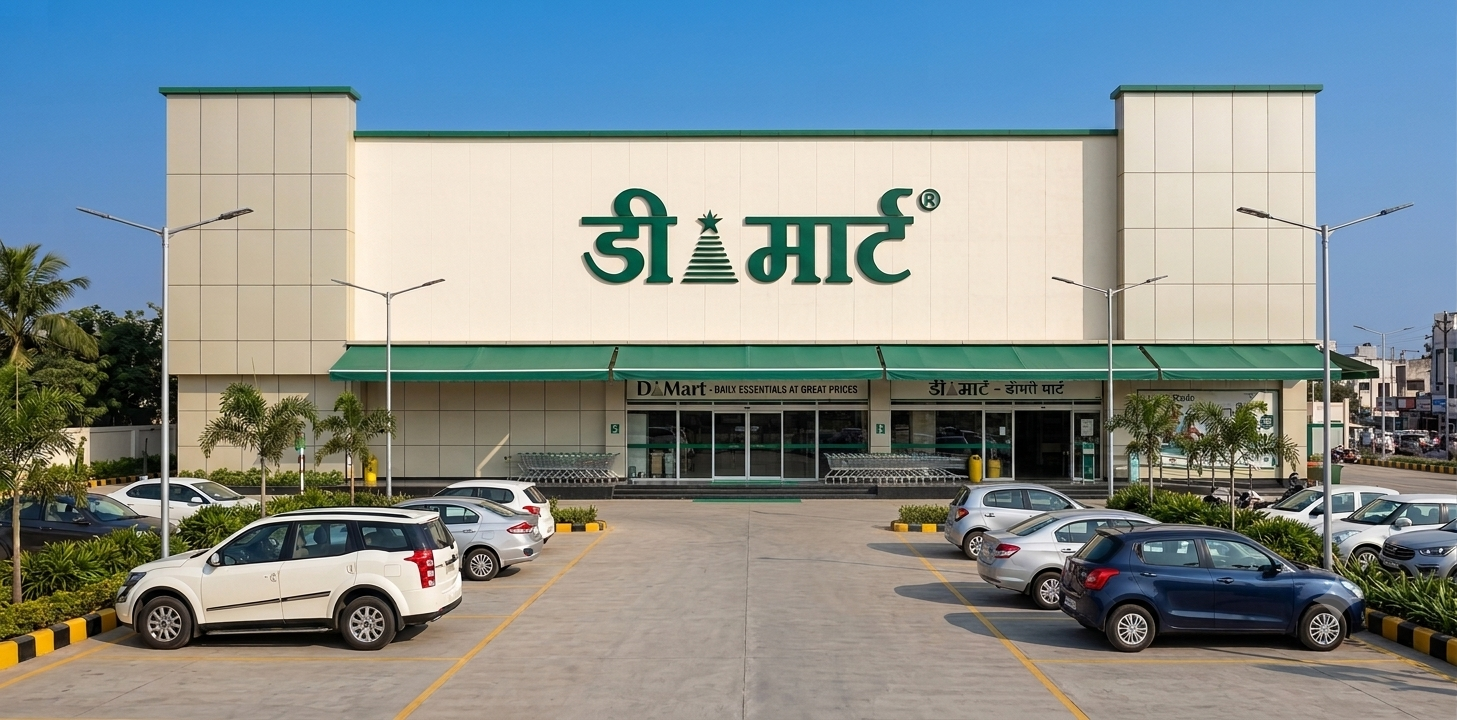
In May 2002, a former stockbroker named Radhakishan Damani opened a single supermarket in the Hiranandani Gardens area of Powai, Mumbai. He called it DMart, short for Damani Mart. Damani had spent the previous two decades as a value investor on Dalal Street, mentoring a young Rakesh Jhunjhunwala and building a reputation for buying things only when they were cheap relative to their worth. He applied the same philosophy to retail: buy real estate instead of leasing it, sell at the lowest possible price, keep costs to the bone, and grow only as fast as the balance sheet allows. Twenty four years later, that single store has become Avenue Supermarts Limited, operator of 500 DMart stores as of March 2026, with annual revenue of Rs 66,968 crore and a reputation as the most profitable large-format retailer in India. The comparison to Walmart, the American retailer built on a near-identical everyday low price philosophy, is one DMart has earned through its business model rather than through scale, and this article examines exactly where that comparison holds and where it does not.
Table of Contents
- Part I: Radhakishan Damani and the Founding of DMart (2000 to 2010) The investor who became a retailer, the first store, and the slow expansion years
- Part II: The Business Model: Everyday Low Price and Owned Real Estate EDLC-EDLP, why DMart buys rather than leases, and the cluster expansion strategy
- Part III: Store Formats, Product Categories, and Private Labels Hypermarkets, Express stores, SuperCenters, and brands like DMart Premia and Minimax
- Part IV: The 2017 IPO and the Stock Market Years India’s most oversubscribed large IPO, the 102% listing day gain, and what followed
- Part V: Shareholding Structure and Why DMart Has Never Paid a Dividend Promoter holding, the path to SEBI’s minimum public shareholding norm, and capital allocation choices
- Part VI: FY2024 to FY2026 Financials and the Path to 500 Stores Revenue crossing Rs 66,968 crore, margin pressure, and the fastest year of store additions ever
- Part VII: The Competitive Landscape: What Big Bazaar’s Collapse Reveals About DMart Future Retail’s liquidation, Reliance Retail’s scale, and why DMart’s model survived where others did not
- Part VIII: DMart Ready and the E-Commerce Question Avenue E-Commerce, the online grocery experiment, and quick commerce competition
- Part IX: DMart vs Walmart: Where the Comparison Holds and Where It Breaks Down Shared philosophy, vastly different scale, and Walmart’s own presence in India
- Frequently Asked Questions
Rs 66,968 cr
Avenue Supermarts’ total revenue from operations in FY2026, up from Rs 57,790 crore in FY2025, a year on year increase of approximately 16%.
500
Total DMart stores as of March 31, 2026, after the company added 85 new stores during FY2026, its highest ever annual addition.
104.5x
Oversubscription of DMart’s March 2017 IPO, which raised Rs 1,870 crore at a price band of Rs 295 to Rs 299 and listed at a 102% premium.
Rs 3,224 cr
Net profit after tax for FY2026, up from Rs 2,927 crore in FY2025 and Rs 2,536 crore in FY2024.
Part IRadhakishan Damani and the Founding of DMart (2000 to 2010)
From Dalal Street to Powai
Radhakishan Shivkishan Damani was born in 1955 in Bikaner, Rajasthan, and built his career in Mumbai as a stockbroker and value investor. Over more than two decades on Dalal Street, Damani became known for a disciplined, fundamentals-driven investing style, and was an early mentor to Rakesh Jhunjhunwala, who himself went on to become one of India’s best-known investors. Damani’s investment portfolio over the years included early stakes in companies such as HDFC Bank and Nestle India, holdings that reflected the same long-term, value-oriented approach he would later apply to retail.
Around the year 2000, at the age of approximately 45, Damani began shifting his focus from public market investing toward building a retail business of his own. Avenue Supermarts Private Limited was incorporated in Mumbai in 2000, and on May 15, 2002, the company opened its first DMart store in the Hiranandani Gardens area of Powai, Mumbai. The choice of name, DMart, was a straightforward abbreviation of Damani Mart. From the outset, the store was structured around a simple proposition: a wide assortment of everyday household essentials, groceries, and apparel, sold at prices consistently lower than competitors, in a larger format than the typical Indian grocery store of the time.
What an investor’s mindset brought to retail: Damani’s background as a value investor shaped DMart’s retail strategy in ways that distinguished it from most Indian retail chains of the 2000s. Where many competitors leased store space and prioritised rapid geographic expansion to build scale quickly, often funded by external capital, DMart prioritised owning the real estate underneath its stores wherever financially feasible, kept its expansion pace deliberately slow, and avoided taking on the kind of debt that would force aggressive store rollouts before the underlying unit economics were proven. This was, in effect, a value investing thesis applied to physical retail: acquire good assets at reasonable prices, hold them, and let compounding do the work over a long time horizon.
The Slow Expansion Years
DMart’s growth through the 2000s was deliberately gradual. The chain grew to 29 stores across Maharashtra and Gujarat by 2010, eight years after its first store opened. This pace stood in sharp contrast to several venture-funded and corporate-backed retail chains launched in India during the same period, many of which expanded into dozens of cities within a few years and subsequently struggled with unprofitable stores and high lease costs. By 2012, DMart had reached 50 stores, growing to 75 stores by 2014. In 2016, the chain crossed 110 stores and, for the first time, crossed Rs 7,500 crore in annual turnover, a milestone that set the stage for the company’s entry into the public markets the following year.
-
2000Avenue Supermarts incorporated
Radhakishan Damani incorporates Avenue Supermarts Private Limited in Mumbai, beginning the transition from public market investing to organised retail.
-
May 15, 2002First DMart store opens in Powai, Mumbai
The store opens in the Hiranandani Gardens area, built around an everyday low price model and a larger-than-typical store format for the time.
-
201029 stores across Maharashtra and Gujarat
Eight years after the first store, DMart’s deliberately slow expansion has produced 29 stores, most operating in formats up to 30,000 square feet, larger than the typical 4,000 square foot leased grocery format common among competitors.
-
2012 to 2014Store count grows from 50 to 75
Expansion continues at a measured pace, with new stores added primarily in markets adjacent to existing clusters in western India.
-
2016110 stores; crosses Rs 7,500 crore turnover
DMart reaches a scale milestone that demonstrates the viability of its model at a size large enough to support a public listing.
-
Mar 2017IPO filed; 112 stores across 41 cities
At the time of its IPO filing, DMart operates 112 stores across 41 cities, supported by 21 distribution centres and 6 packing centres in Maharashtra, Gujarat, Telangana, and Karnataka.
-
Mar 2023324 stores
The chain crosses 324 stores, having added 40 new stores during FY2023, with FY2023 revenue of Rs 42,840 crore and an EBITDA margin of 8.5%.
-
Mar 2024365 stores; revenue Rs 50,789 crore
Revenue grows approximately 19% year on year. Net profit reaches Rs 2,536 crore with an EBITDA margin of 8.1%, a slight decline from the prior year’s 8.5%.
-
Mar 2025415 stores; revenue Rs 57,790 crore
Revenue grows approximately 16.7% year on year. Net profit reaches Rs 2,927 crore. EBITDA margin falls further to 7.9%, reflecting rising labour and operating costs.
-
Mar 2026500 stores; revenue Rs 66,968 crore
FY2026 sees the highest ever annual store addition at 85 new stores, including 58 in the final quarter alone. Net profit reaches Rs 3,224 crore.
Part IIThe Business Model: Everyday Low Price and Owned Real Estate
EDLC and EDLP
DMart’s operating philosophy is often summarised by two linked acronyms: Every Day Low Cost, abbreviated EDLC, and Every Day Low Price, abbreviated EDLP. The logic runs in one direction: a retailer can only sustainably offer low prices to customers every day, rather than through periodic promotions and discounts, if its own cost structure is kept low every day. DMart pursues EDLC through several mechanisms. It negotiates directly with a large number of suppliers, often paying them faster than industry norms in exchange for better pricing, since DMart’s strong cash position allows it to avoid the extended payment cycles that strain supplier relationships at many other retailers. It buys in bulk and stores inventory efficiently through a network of distribution and packing centres. It avoids heavy spending on advertising and marketing, relying instead on word of mouth and repeat visits driven by price competitiveness.
The most distinctive element of DMart’s cost structure, however, is its approach to real estate. Where most Indian retail chains lease their store premises, often on long-term leases with periodic rent escalations, DMart has historically aimed to own the land and building underlying a significant share of its stores wherever financially viable. Owning property eliminates a major recurring cost, rent, that for leased retailers can represent a substantial share of operating expenses and is subject to renegotiation risk every few years. The trade-off is that owning real estate requires significantly more upfront capital per store, which is one of the key reasons DMart’s expansion has historically been slower than that of leasing-based competitors. It is also a key reason the company has historically avoided high leverage: owning property outright, funded through internal accruals and equity rather than debt, keeps the balance sheet simple and the interest burden low.
Cluster-Based Expansion
Rather than entering many cities simultaneously, DMart has followed a cluster-based expansion strategy, opening multiple stores within a region before moving into adjacent regions. This approach has several benefits. It allows a single distribution centre to efficiently serve multiple nearby stores, reducing logistics costs per store. It allows the company to build supplier relationships and brand recognition within a region before committing further capital elsewhere. And it allows store-level staff and management practices, refined in one cluster, to be replicated with minimal adjustment in adjacent clusters. This is part of why DMart’s store base, even at 500 locations, remains concentrated in certain states, particularly Maharashtra, Gujarat, Telangana, Karnataka, and Andhra Pradesh, rather than being evenly spread across all of India.
What DMart does not do, and why it matters: A significant part of understanding DMart’s model is understanding what the company has deliberately avoided. It has not pursued an aggressive national advertising campaign of the kind common among Indian retail and e-commerce companies. It has not relied on private label products as its primary growth lever to the extent that some competitors have, though it does carry private label and in-house brands across several categories. It has not taken on significant debt to fund expansion. And until relatively recently, it did not invest heavily in e-commerce, choosing instead to perfect the physical store model first. Each of these choices reflects the same underlying philosophy: grow only as fast as profitable unit economics allow, and do not sacrifice the balance sheet for the sake of growth rate.
Part IIIStore Formats, Product Categories, and Private Labels
Three Store Formats for Three Kinds of Locations
DMart operates its retail network across three distinct store formats, each suited to a different kind of catchment area. The most common format is the Hypermarket, typically spread across 30,000 to 35,000 square feet, which forms the backbone of DMart’s store network and is what most customers picture when they think of a DMart store. The Express format is a smaller footprint store, typically 7,000 to 10,000 square feet, designed for locations where a full-sized hypermarket would either be unavailable or unnecessary, such as denser urban neighbourhoods where large contiguous retail space is harder to find. At the upper end, DMart has also developed SuperCenters, which exceed 100,000 square feet and combine the grocery and general merchandise assortment of a hypermarket with additional categories and a significantly larger footprint, typically located in markets that can support a higher volume of footfall.
Within these formats, DMart organises its merchandise into three broad categories. The Foods category includes groceries, staples, processed foods, dairy products, frozen items, beverages, and confectionery, and is typically the highest-frequency, highest-footfall category that brings customers into the store regularly. The Non-Foods FMCG category covers home care products such as cleaning supplies, personal care items, toiletries, and over-the-counter health products. The General Merchandise and Apparel category is the broadest in terms of product variety, spanning bed and bath linen, toys and games, crockery and kitchenware, garments, footwear, utensils, and small home appliances. This category typically carries higher margins than groceries and plays an important role in DMart’s overall profitability, even though groceries and FMCG products drive the majority of footfall and transaction frequency.
DMart’s Private Label Brands
Avenue Supermarts has built a portfolio of private label, or in-house, brands that are sold exclusively through DMart stores and DMart Ready. These include DMart Premia, a brand generally positioned for higher-quality or premium variants of everyday products, DMart Minimax, D Homes, which covers home and kitchen products, and Dutch Harbour, which is used across categories including personal care and household items. These private label products span categories from home care items such as toilet cleaners, dish wash gels, and room fresheners, to personal care products such as hair oil, soaps, and toothbrushes, to food items such as green tea, coffee, biscuits, and cereal, to home decor items such as tableware and small kitchen appliances.
Why private labels matter to DMart’s margin structure: As of 2023, private label products were estimated to account for approximately 10% of DMart’s total sales. While this is a meaningful share, it is notably lower than the private label penetration seen at many Western retailers, including Walmart, where store brands can represent a much larger share of sales in certain categories. The reason private labels matter disproportionately to DMart’s profitability despite their modest share of revenue is margin structure: private label products typically carry significantly higher gross margins than branded equivalents, because DMart captures the margin that would otherwise go to a third-party brand’s marketing, distribution, and brand equity costs. A private label strategy that grows from 10% of sales toward a higher share over time, without requiring DMart to compromise on its everyday low price positioning relative to branded alternatives, represents one of the more straightforward margin expansion levers available to the company, and is one of the areas analysts watch closely when assessing DMart’s medium-term profitability trajectory.
Operating Hours and the Footfall-Driven Model
DMart stores typically operate from around 7 am to 11 pm, longer hours than many traditional Indian retail formats. This is a deliberate choice: a retailer only extends its operating hours if it is confident that footfall will justify the additional staffing and operating costs across those extra hours. The long operating hours reflect DMart’s positioning as a destination for the weekly or monthly household shopping trip, where customers may visit at varying times depending on their work schedules, rather than a convenience store designed for quick, frequent visits.
Part IVThe 2017 IPO and the Stock Market Years
India’s Most Oversubscribed Large IPO
Avenue Supermarts filed for its initial public offering with the Securities and Exchange Board of India, opening for subscription between March 8 and March 10, 2017, with a price band of Rs 295 to Rs 299 per share. The issue size was Rs 1,870 crore. The IPO received bids for approximately 463.61 crore shares against an issue size of 4.43 crore shares, an oversubscription of approximately 104.5 times, one of the highest subscription levels for a large Indian IPO at that time. The retail and institutional response reflected investor enthusiasm for a profitable, debt-light retail business with a long track record, at a time when investor sentiment toward many other Indian retail and e-commerce ventures was far more cautious due to their persistent losses.
Shares of Avenue Supermarts listed on the BSE and NSE on March 21, 2017. The stock opened at Rs 604.40 on the BSE, a premium of approximately 102% over the issue price of Rs 299, and closed the day at Rs 640.75, a gain of approximately 114% from the issue price. At listing, the company commanded a market valuation of approximately Rs 37,199 crore. The stock’s strong debut was widely covered as one of the standout IPO listings of that period in the Indian market, reflecting both the scarcity of profitable, large-scale retail businesses available to public market investors in India and confidence in the DMart model specifically.
Why DMart’s IPO stood out in 2017: At the time of its listing, much of the excitement in Indian consumer technology and retail was concentrated in venture-funded e-commerce companies that were growing revenue quickly but losing significant amounts of money, with profitability presented as a distant future goal. DMart represented the opposite profile: a company that had taken fifteen years to reach 112 stores, had never relied on aggressive discounting funded by external capital, and was already solidly profitable with healthy margins by the standards of the grocery retail sector. For public market investors seeking exposure to India’s consumption growth story without the cash-burn profile of e-commerce, DMart offered a rare combination of scale, profitability, and a long operating track record, which is reflected in the valuation premium the market assigned to the stock at listing and in the years that followed.
Part VShareholding Structure and Why DMart Has Never Paid a Dividend
From 91% to 74.65%: The Promoter Stake Over Time
At the time of its March 2017 IPO, the promoter group led by Radhakishan Damani and his close family members, including Gopikishan Damani, Shrikantadevi Damani, and Kirandevi Damani, held approximately 91.34% of Avenue Supermarts. Indian securities regulations under SEBI require listed companies to maintain a minimum public shareholding of 25%, meaning promoter holding cannot exceed 75% on an ongoing basis. As of March 2018, the promoter group’s holding stood at approximately 82.2%, with Radhakishan Damani individually holding approximately 39.41%. The company was therefore required to bring promoter holding down over time to comply with the 25% public float requirement.
This was accomplished through a series of offer-for-sale transactions in which the promoters sold small portions of their stake to public investors. In May 2018, Radhakishan Damani sold up to 1% of the company through the open market. In February 2020, the promoter group, comprising Radhakishan Damani, Gopikishan Damani, Shrikantadevi Damani, and Kirandevi Damani, conducted an offer for sale of approximately 2.28% of the company at a floor price of Rs 2,049 per share, which was oversubscribed by both institutional and retail investors. This reduced the promoter stake from approximately 79.73% as of December 2019 to 74.99% as of February 2020, bringing the company into compliance with the minimum public shareholding norm. As of June 2025, the promoter and promoter group holding stood at approximately 74.65%, with Radhakishan Damani individually holding approximately 23.03%, making him still the single largest individual shareholder in the company by a wide margin.
What the shareholding pattern signals: The reduction in promoter holding from over 91% to approximately 74.65% was driven by regulatory compliance requirements rather than by any change in the promoter group’s confidence in the business. Since reaching the 74.65% level required by the minimum public shareholding norm, the promoter holding has remained essentially stable, a pattern that is often read by market participants as a signal of continued long-term commitment from the founding family. Institutional ownership has grown gradually over time, with mutual funds holding approximately 7.63% and foreign institutional investors holding approximately 8.18% as of recent disclosures, while ICICI Prudential Mutual Fund has historically been among the largest individual institutional shareholders, holding approximately 2.82%.
No Dividends Despite Consistent Profits
Despite reporting consistent annual profits since well before its IPO, and despite profits growing from Rs 2,378 crore in FY2023 to Rs 3,224 crore in FY2026, Avenue Supermarts has not paid a dividend to its shareholders in any year since listing. This is a deliberate capital allocation choice rather than a reflection of financial distress. The company has instead retained its profits to fund continued store expansion, which, given DMart’s preference for owning real estate rather than leasing it, requires substantially more capital per new store than a leasing-based competitor would need.
For long-term shareholders, the absence of dividends has historically been offset by share price appreciation, reflecting the market’s view that DMart can generate higher returns by reinvesting capital into new, owned stores than shareholders could achieve by receiving that capital as dividends and reinvesting it themselves. Whether this remains the optimal capital allocation policy as the company’s store base matures and its return on equity, which has been reported at approximately 13.6% over recent years, is a question that may receive more attention from investors as DMart’s growth rate eventually moderates from its current pace.
Part VIFY2024 to FY2026 Financials and the Path to 500 Stores
Revenue Growth Against Margin Pressure
Avenue Supermarts’ revenue from operations grew from Rs 42,840 crore in FY2023 to Rs 50,789 crore in FY2024, an increase of approximately 19%, and further to Rs 57,790 crore in FY2025, an increase of approximately 16.7%. For FY2026, revenue reached Rs 66,968 crore, an increase of approximately 16% over FY2025. This consistent double-digit revenue growth has been driven primarily by the addition of new stores and by growth in like-for-like sales at stores that have been operating for two years or more, which management refers to internally as same-store sales growth.
Profitability, however, has shown a more mixed picture. EBITDA margin declined from 8.5% in FY2023 to 8.1% in FY2024 and further to 7.9% in FY2025, reflecting rising labour costs, increased competitive intensity in some categories, and the costs associated with the company’s expanding e-commerce operations. Net profit after tax nonetheless grew across this period, from Rs 2,378 crore in FY2023 to Rs 2,536 crore in FY2024, to Rs 2,927 crore in FY2025, and to Rs 3,224 crore in FY2026, as the absolute scale of the business more than compensated for the modest margin compression.
Avenue Supermarts: Revenue and Net Profit, FY2023 to FY2026
All figures in Rs crore. Source: Avenue Supermarts Limited quarterly and annual results filed with BSE and NSE.
The Fastest Year of Store Growth in Company History
FY2026 marked a clear acceleration in DMart’s store expansion pace relative to its historical norms. The company added 85 new stores during the year, the highest annual addition in its 24-year history, including 58 stores in the fourth quarter alone, also a single-quarter record. This brought the total store count to 500 as of March 31, 2026. For comparison, the company added approximately 50 stores in FY2025 and approximately 41 stores in FY2024. Management commentary alongside the FY2026 results noted that stores aged two years or older grew sales by 10.8% during the fourth quarter, an improvement from 8.1% in the same quarter of the prior year, suggesting that the accelerated new store additions have not come at the expense of the productivity of the existing store base.
DMart Store Count: 2002 to 2026
Total number of DMart stores at selected points in time, illustrating the shift from slow early expansion to the accelerated pace of FY2026.
| Metric | FY2023 | FY2024 | FY2025 | FY2026 |
|---|---|---|---|---|
| Revenue from Operations (Rs crore) | 42,840 | 50,789 | 57,790 | 66,968 |
| Net Profit After Tax (Rs crore) | 2,378 | 2,536 | 2,927 | 3,224 |
| EBITDA Margin | 8.5% | 8.1% | 7.9% | Improving (per Q4 commentary) |
| Total Store Count (as of March 31) | 324 | 365 | 415 | 500 |
| New Stores Added During Year | 40 | 41 | 50 | 85 |
Part VIIThe Competitive Landscape: What Big Bazaar’s Collapse Reveals About DMart
The Rise and Fall of Big Bazaar
No discussion of DMart’s model is complete without considering the fate of the retail chain it is most often contrasted with: Big Bazaar, the flagship hypermarket brand of Kishore Biyani’s Future Group. Big Bazaar was founded approximately two decades before DMart’s IPO and, for much of the 2000s and early 2010s, was the dominant large-format retail brand in India, with Biyani earning the title of father of modern retail in India for popularizing the hypermarket format. At its peak, Future Group operated more than 1,700 retail outlets across formats including Big Bazaar, fbb, Foodhall, Easyday, HyperCity, and Nilgiris.
Future Retail Limited, the listed entity operating these formats, ran into severe financial difficulty in 2020. The COVID-19 pandemic forced store closures during lockdowns, and the company’s revenue fell by approximately 74% year on year in the quarter ended September 2020, posting a net loss of Rs 692.36 crore for that quarter, followed by a further net loss of approximately Rs 847 crore in the following quarter as revenue remained down approximately 71% year on year. By 2020, Future Retail had accumulated debt exceeding Rs 13,000 crore. In August 2020, Future Group agreed to sell its retail, wholesale, and logistics businesses, including Big Bazaar, to Reliance Retail for approximately Rs 24,713 crore. However, this deal was challenged by Amazon, which had previously invested in a Future Group entity and argued the sale violated its prior agreement, and the Singapore International Arbitration Centre issued an interim order barring the asset transfer. The resulting legal battle dragged on for years, during which Future Retail’s operations continued to deteriorate.
In early 2022, with Future Retail unable to pay rent on many of its leased properties, Reliance Retail, which held many of the underlying leases, began terminating sub-leases and taking control of approximately 950 Future Group stores, including 835 Future Retail stores such as Big Bazaar outlets and 112 Future Lifestyle stores, representing around a third of Future’s entire retail network. In July 2022, Future Retail was admitted into Corporate Insolvency Resolution Process by the NCLT following a petition from lender Bank of India over a default of Rs 3,495 crore, with total admitted creditor claims eventually exceeding Rs 19,000 crore. Despite multiple extensions, the CIRP failed to produce a viable resolution plan, and in April 2024, the NCLT ordered Future Retail’s liquidation. By 2025, the Big Bazaar brand name itself, along with other Future Group brands such as Foodhall, was put up for auction by the liquidator with a reserve price of approximately Rs 155.85 crore, a fraction of what the brand had once been worth.
Why Big Bazaar’s collapse and DMart’s growth are two sides of the same lesson: Big Bazaar and DMart pursued nearly opposite strategies on the dimensions that ultimately determined their fates. Big Bazaar grew rapidly to more than 1,700 outlets primarily through leased properties, which meant that when the pandemic eliminated revenue for months, the company still owed rent on its entire leased footprint with no corresponding income, a fixed cost burden that owned real estate does not impose in the same way. Big Bazaar’s parent group had also taken on substantial debt to fund its expansion and diversification into formats beyond retail, which meant that a sustained revenue shock translated quickly into loan defaults and loss of control over its own stores to its landlord, which in this case was Reliance Retail itself. DMart’s slower, owned-property, low-debt expansion meant that during the same pandemic period, while DMart’s revenue also declined during lockdown months, the company did not face the same combination of rent obligations on empty stores and looming debt covenant breaches. This is not to say DMart’s model is risk-free or universally superior in all circumstances, but the contrast between the two companies’ outcomes through 2020 to 2024 is one of the clearest real-world illustrations of why DMart’s founders prioritised the choices they did, even when those choices meant growing more slowly for two decades.
Reliance Retail: A Different Kind of Competitor
While Big Bazaar’s collapse removed DMart’s most direct historical large-format competitor, it simultaneously strengthened the position of Reliance Retail, the retail arm of Reliance Industries, which absorbed many of Future Group’s former store locations and has continued to expand its own grocery formats, including Reliance Smart and Reliance Fresh, alongside its broader retail empire spanning electronics, fashion, and its majority-owned e-commerce platform JioMart. Reliance Retail operates at a scale that significantly exceeds DMart’s in terms of total store count and category breadth, backed by the much larger balance sheet of Reliance Industries as a whole.
However, Reliance Retail’s grocery and hypermarket formats compete with DMart on a different basis than Big Bazaar did. Where Big Bazaar’s failure was rooted in financial structure, leased properties and high debt, Reliance Retail’s grocery business is backed by one of India’s largest and most cash-generative conglomerates, meaning it does not face the same existential financial fragility. The competitive question between DMart and Reliance Retail’s grocery formats is therefore less about financial survival and more about which company can sustain lower prices and better unit economics over the long run, given that DMart’s model is built specifically around cost discipline at the store level, while Reliance’s advantage lies more in its scale across the entire conglomerate and its ability to cross-subsidise across businesses if it chooses to.
Part VIIIDMart Ready and the E-Commerce Question
Avenue Supermarts operates its online grocery delivery business, DMart Ready, through a subsidiary called Avenue E-Commerce Limited. Unlike its core physical retail business, where DMart has been a clear success story, the e-commerce arm has had a more difficult journey, reflecting the broader challenges that online grocery delivery has faced as a category in India, particularly with the rise of quick commerce competitors offering delivery within ten to twenty minutes.
As of the FY2026 fourth quarter results, the company disclosed that DMart Ready had ceased operations in one city and was refocusing its efforts on major metro cities, operating in 18 cities with an emphasis on home delivery rather than the pickup-point model the service had originally emphasised in some markets. This represents a recalibration rather than an abandonment of the e-commerce effort: the core physical store business remains DMart’s primary growth engine and the dominant contributor to revenue and profit, while DMart Ready is being repositioned as a complementary channel in the markets where it can operate efficiently alongside the company’s existing distribution infrastructure, rather than as a separate national growth story in its own right.
Why quick commerce is a genuine strategic challenge for DMart’s model: DMart’s core advantages, owned real estate, large stores, bulk purchasing, and low operating costs per unit of revenue, are advantages built around customers physically visiting a large store and buying in bulk for the week or month. Quick commerce platforms, which deliver small basket sizes within minutes from dense networks of small dark stores, address a different use case: topping up between large shopping trips. The two models are not necessarily mutually exclusive, since a household might do its large monthly grocery shop at a DMart store while using quick commerce for last-minute items. However, if quick commerce platforms expand their assortment and pricing aggressively enough to capture a meaningful share of the large basket use case as well, DMart’s core value proposition could face pressure in dense urban markets, even if its tier-2 and tier-3 city stores, where quick commerce has limited reach, remain relatively insulated. The DMart Ready recalibration toward metro home delivery can be read as an attempt to participate in this shift rather than cede it entirely.
Part IXDMart vs Walmart: Where the Comparison Holds and Where It Breaks Down
Where the Comparison Holds
The comparison between DMart and Walmart is rooted in genuine philosophical similarity, not just branding. Walmart was founded in 1962 by Sam Walton and his brother Bud Walton in Rogers, Arkansas, built explicitly around the everyday low price concept, and grew over decades into the world’s largest retailer through a combination of cost discipline, supplier negotiation, efficient logistics, and a deliberate avoidance of high-margin, low-turnover positioning. DMart’s founders have cited similar principles, and the resemblance in stated philosophy, sell more for less, keep costs low every day rather than through periodic promotions, and let scale and efficiency drive profitability, is real and was part of why the “Walmart of India” framing took hold among Indian investors and commentators in the years following DMart’s IPO.
Both companies have also historically emphasised owning significant portions of their real estate rather than leasing, both have built large-format stores designed for one-stop, bulk shopping trips, and both have built reputations as some of the most operationally efficient retailers in their respective markets, reflected in profitability metrics that are difficult for less disciplined competitors to match.
Where the Comparison Breaks Down
The differences, however, are substantial, and mostly come down to scale and geographic reach. Walmart’s fiscal year 2025 revenue was approximately 681 billion US dollars, operating more than 10,750 stores across 19 countries and serving approximately 270 million customers per week, with approximately 2.1 million employees worldwide. DMart’s FY2026 revenue of Rs 66,968 crore converts to approximately 7.8 billion US dollars at typical exchange rates, meaning Walmart’s revenue is roughly 87 times larger than DMart’s. Walmart operates globally across multiple formats, including supercenters, neighbourhood markets, and Sam’s Club warehouse clubs, and has built one of the world’s largest e-commerce operations alongside its physical stores. DMart, by contrast, operates exclusively within India, in a single store format with limited variation, and its e-commerce arm remains a small and recently recalibrated part of the overall business.
| Dimension | DMart (Avenue Supermarts) | Walmart Inc. |
|---|---|---|
| Founded | 2002, Mumbai, India | 1962, Rogers, Arkansas, US |
| Founder(s) | Radhakishan Damani | Sam Walton and Bud Walton |
| FY2025/26 Revenue | Rs 66,968 crore (approx. $7.8 billion) | Approx. $681 billion |
| Number of Stores | 500 (March 2026, India only) | 10,750+ across 19 countries |
| Core Philosophy | Everyday Low Price, owned real estate | Everyday Low Price, owned real estate |
| E-commerce Scale | DMart Ready, recalibrating, 18 cities | $120.9 billion in online sales (FY2025) |
| Geographic Footprint | India only, concentrated in western and southern states | Global, 19 countries |
| Listing Status | Listed on BSE and NSE since March 2017 | Listed on NYSE since 1972 |
Walmart Is Already in India, Just Not as DMart’s Direct Competitor
An important nuance often missed in the “Walmart of India” framing is that Walmart itself already operates in India, through two distinct channels that are structurally different from DMart’s consumer retail business. Walmart holds a majority stake in Flipkart, one of India’s largest e-commerce platforms, acquired in 2018, giving Walmart substantial indirect exposure to Indian consumer spending through online retail. Separately, Walmart operates Best Price Modern Wholesale stores in India, a business-to-business cash-and-carry format that sells to small retailers, restaurants, and other businesses rather than directly to individual consumers, a structure required under India’s foreign direct investment rules for multi-brand retail at the time these stores were established.
This means that DMart and Walmart do not compete head-to-head in the same segment within India. DMart is a business-to-consumer hypermarket chain. Walmart’s direct presence in India is business-to-business wholesale, while its consumer-facing exposure comes through its stake in Flipkart’s e-commerce platform. The “Walmart of India” label, then, is best understood as a description of DMart’s business philosophy and operational discipline relative to the original Walmart model in its early decades, rather than as a claim that DMart and Walmart occupy the same competitive space in the Indian market.
Scale Comparison: DMart vs Walmart (Indexed to Walmart = 100)
Annual RevenueDMart is approx. 1.1% of Walmart’s revenue
Store CountDMart has approx. 4.6% of Walmart’s store count
Geographic ReachDMart: 1 country vs Walmart: 19 countries
Note: These ratios illustrate the difference in absolute scale between the two companies. They are not intended to suggest that DMart is “behind schedule” relative to Walmart, since the two companies operate in different markets, at different points in their respective histories, with different growth strategies.
What DMart’s Story Actually Represents
DMart’s twenty four year journey from a single store in Powai to a 500-store, Rs 66,968 crore revenue business is one of the clearest demonstrations in Indian corporate history of what disciplined, patient capital allocation can achieve in a capital-intensive industry. The decision to own real estate rather than lease it, to expand in clusters rather than chase national headlines, and to avoid debt even when it meant growing more slowly than competitors, are choices that took years to pay off but that ultimately produced one of the most profitable retail businesses in the country, run by a company whose founder approached retail with the same patience he had applied to public market investing for two decades before that.
The Walmart comparison is useful as a description of philosophy: both companies were built on the conviction that low prices, sustained through genuinely lower costs rather than periodic discounting, would compound into customer loyalty and operational scale over time. But the comparison should not be mistaken for a claim of equivalent scale or competitive positioning. Walmart is a global retailer with revenue roughly 87 times larger than DMart’s, operating across 19 countries, with an e-commerce business alone that generates more revenue than DMart’s entire company. DMart, meanwhile, remains an India-focused, single-format retailer that has only in FY2026 begun to meaningfully accelerate its store expansion pace after two decades of deliberate caution.
The more interesting question for DMart’s next chapter is not whether it can become as large as Walmart globally, an unlikely and perhaps not even desirable goal given how different the two markets are, but whether the same disciplined model that worked for getting to 500 stores in India’s metro and tier-2 cities can be extended into the smaller towns where much of India’s future retail growth is expected to occur, and whether the company’s recalibrated approach to e-commerce can find a sustainable place alongside the quick commerce platforms that have reshaped urban grocery shopping habits in the years since DMart’s IPO. The answers to those questions, more than any comparison to a company on the other side of the world, will determine what DMart looks like in another twenty four years.
Frequently Asked Questions
DMart was founded by Radhakishan Shivkishan Damani, a Mumbai-based stockbroker and value investor who had spent over two decades on Dalal Street before moving into retail around the year 2000. The name DMart is a shortened form of Damani Mart. The company that operates DMart, Avenue Supermarts Limited, was incorporated in Mumbai in 2000, and the first DMart store opened on May 15, 2002, in the Hiranandani Gardens area of Powai, Mumbai.
Damani’s prior career as a value investor, during which he was an early mentor to investor Rakesh Jhunjhunwala and held long-term stakes in companies such as HDFC Bank and Nestle India, shaped the philosophy he applied to DMart: prioritise owning assets over leasing them, grow only as fast as the underlying economics justify, and avoid taking on debt to accelerate expansion artificially.
Everyday Low Price, or EDLP, means that DMart aims to offer consistently low prices on its products at all times, rather than relying on periodic sales, festival discounts, or promotional pricing that many retailers use to drive footfall. The companion concept is Every Day Low Cost, or EDLC, which refers to DMart’s effort to keep its own operating costs low on a continuous basis, since a retailer can only sustainably offer low prices every day if its cost base genuinely supports that pricing.
DMart pursues EDLC through several mechanisms: paying suppliers faster than industry norms in exchange for better pricing terms, buying in bulk through a network of distribution centres, owning a significant share of its store real estate to avoid recurring rent costs, and minimising spending on advertising and marketing. The combination of EDLC and EDLP is the foundational logic behind DMart’s business model and is the same logic that underpinned Walmart’s growth in the United States from the 1960s onward.
Avenue Supermarts’ IPO opened for subscription on March 8, 2017, with a price band of Rs 295 to Rs 299 per share, and raised Rs 1,870 crore. The issue was oversubscribed approximately 104.5 times, one of the highest subscription levels for a large Indian IPO at that time. Shares listed on the BSE and NSE on March 21, 2017, opening at Rs 604.40, a premium of approximately 102% over the issue price, and closing the day at Rs 640.75, a gain of approximately 114%. The company’s market valuation at listing was approximately Rs 37,199 crore.
In the years since listing, the stock has been one of the more closely watched names in Indian retail, with its valuation often reflecting a premium multiple relative to other consumer companies, attributed to its consistent revenue growth, strong balance sheet, and debt-free expansion model. As with any listed equity, the share price has fluctuated with broader market conditions and company-specific results, including periods of margin pressure reflected in the EBITDA margin decline from 8.5% in FY2023 to 7.9% in FY2025.
The comparison has real substance at the level of business philosophy: both companies were built around everyday low pricing sustained through genuinely lower operating costs, both have historically emphasised owning real estate rather than leasing it, and both built reputations as unusually efficient operators within their respective retail markets. This shared philosophy is why the comparison emerged organically among Indian investors and commentators rather than being a marketing label DMart created for itself.
However, the scale difference is enormous. Walmart’s fiscal year 2025 revenue was approximately 681 billion US dollars across more than 10,750 stores in 19 countries, while DMart’s FY2026 revenue was Rs 66,968 crore, approximately 7.8 billion US dollars, across 500 stores entirely within India. Walmart’s revenue is roughly 87 times larger than DMart’s. Additionally, Walmart already operates in India, through its majority stake in Flipkart and through its Best Price Modern Wholesale cash-and-carry stores, neither of which compete directly with DMart’s consumer retail format. So the comparison is meaningful as a description of operating philosophy, but should not be read as implying DMart and Walmart are similarly sized or that they compete with each other in the same market segment.
DMart Ready is the online grocery delivery service operated by Avenue Supermarts through its subsidiary, Avenue E-Commerce Limited. It allows customers to order groceries and household items online for home delivery or pickup. Unlike DMart’s core physical store business, which has been consistently profitable and is the primary driver of the company’s growth, DMart Ready has faced a more difficult path, reflecting broader challenges in India’s online grocery sector, particularly the rise of quick commerce platforms that promise delivery within ten to twenty minutes from dense networks of small local warehouses.
As of the FY2026 fourth quarter results, the company disclosed that DMart Ready had stopped operations in one city and was refocusing on major metro areas, operating in 18 cities with a primary emphasis on home delivery. This represents a strategic recalibration rather than an exit from e-commerce: DMart’s core physical retail model, built around large stores, bulk purchasing, and one-stop shopping trips, addresses a different customer need than the small-basket, immediate-delivery use case that quick commerce platforms target, and the company appears to be repositioning DMart Ready to complement rather than replicate that use case.
DMart operates three store formats. The Hypermarket format, typically 30,000 to 35,000 square feet, is the most common and forms the core of DMart’s network. The Express format, typically 7,000 to 10,000 square feet, is used in denser urban locations where large contiguous retail space is harder to find. SuperCenters exceed 100,000 square feet and combine a wider assortment with higher footfall capacity in markets that can support it.
Avenue Supermarts also owns several private label brands sold exclusively through DMart stores and DMart Ready, including DMart Premia, DMart Minimax, D Homes, and Dutch Harbour. These cover categories from groceries and personal care to home decor and small appliances. As of 2023, private labels accounted for approximately 10% of total sales, but carry meaningfully higher margins than branded equivalents, making them an important lever for margin improvement even though they represent a modest share of overall revenue.
At the time of its March 2017 IPO, the Damani family promoter group held approximately 91.34% of Avenue Supermarts. SEBI rules require listed companies to maintain a minimum public shareholding of 25%, so the promoter stake had to be reduced over time. This was done through offer-for-sale transactions in 2018 and February 2020, the latter reducing the promoter holding from approximately 79.73% to 74.99%. As of June 2025, promoter holding stood at approximately 74.65%, with Radhakishan Damani individually holding approximately 23.03%, still the largest individual shareholder by a wide margin.
Despite consistent annual profits, Avenue Supermarts has not paid a dividend in any year since its IPO. This reflects a deliberate decision to retain all profits for funding continued store expansion, particularly because DMart’s preference for owning real estate rather than leasing requires substantially more capital per new store than a leasing-based competitor would need. The market has generally compensated long-term shareholders for this through share price appreciation rather than dividend income, on the view that DMart can generate higher returns by reinvesting capital into new owned stores than shareholders could achieve on their own with a cash dividend.
Big Bazaar was the flagship hypermarket brand of Kishore Biyani’s Future Group, and for much of the 2000s and early 2010s was India’s dominant large-format retail chain, operating across more than 1,700 outlets at its peak. The COVID-19 pandemic caused Future Retail’s revenue to fall by approximately 74% year on year in one quarter of 2020, and the company, which had accumulated debt exceeding Rs 13,000 crore and operated primarily through leased properties, could not sustain the resulting losses. A proposed Rs 24,713 crore sale of Future’s retail assets to Reliance Retail in 2020 was blocked by litigation from Amazon, and by early 2022, Reliance Retail had begun taking over approximately 950 of Future’s store leases due to unpaid rent. Future Retail entered Corporate Insolvency Resolution Process in July 2022, and the NCLT ordered its liquidation in April 2024, with the Big Bazaar brand name itself later put up for auction at a reserve price of approximately Rs 155.85 crore.
The relevance to DMart is structural. Big Bazaar’s collapse was driven substantially by the combination of leased properties, which created rent obligations on stores that generated no revenue during lockdowns, and high debt levels, which turned a temporary revenue shock into permanent loss of control over the business. DMart’s deliberately slower expansion, funded through owned real estate and minimal debt, meant it did not face the same combination of fixed obligations during the same period. This contrast is one of the clearest real-world demonstrations of why DMart’s founders made the choices they did, even though those choices meant the company grew far more slowly than Big Bazaar did during the 2000s and 2010s.
Disclaimer: This article is for informational and educational purposes only and is current as of June 10, 2026. Financial figures for Avenue Supermarts Limited are sourced from the company’s quarterly and annual results filed with BSE and NSE. Figures for Walmart Inc. are sourced from Walmart’s official SEC filings for fiscal year 2025. This article does not constitute investment advice.