Follow us on:


Economy and Energy | June 8, 2026
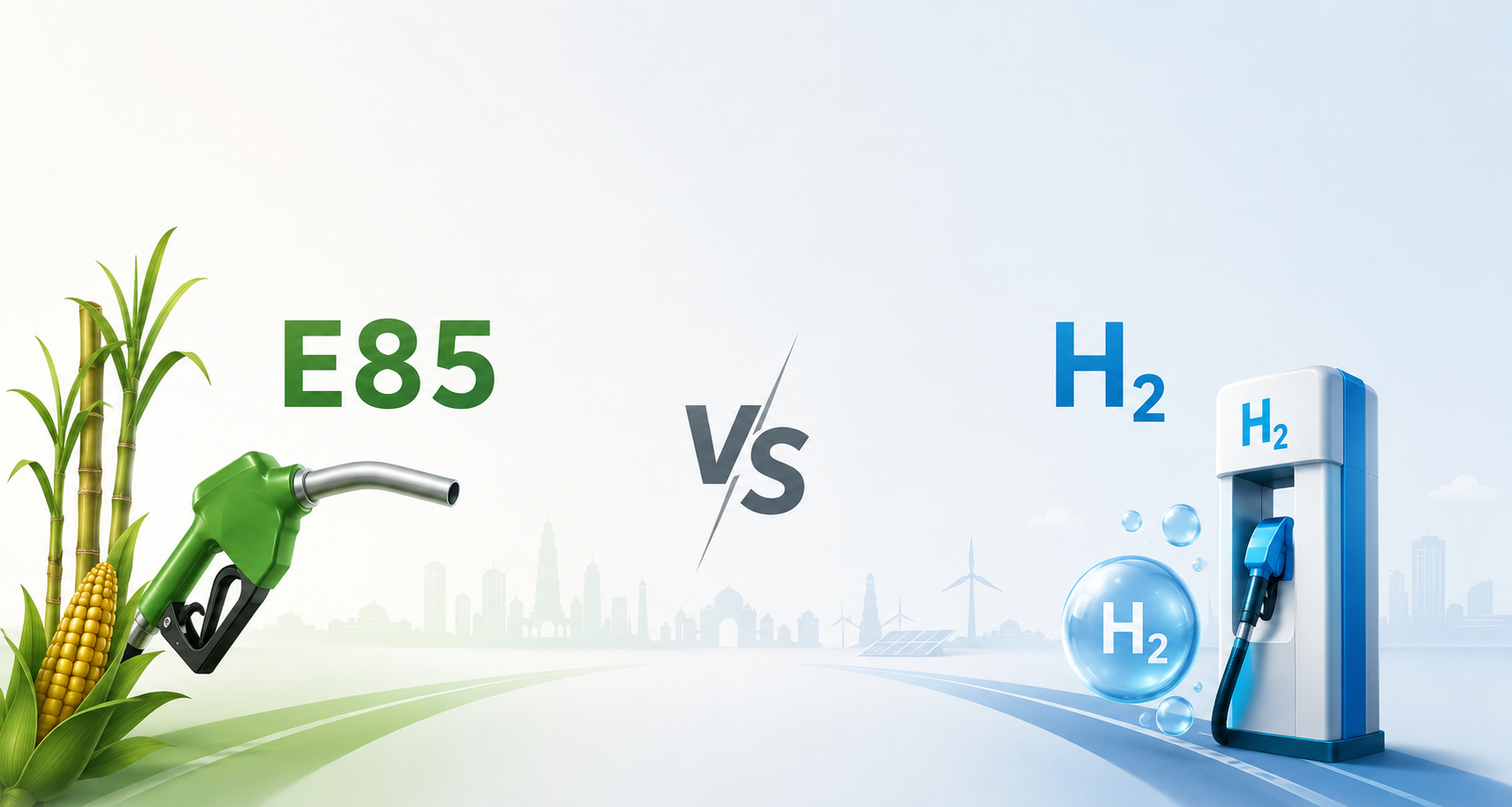
On June 5, 2026, Union Minister Hardeep Singh Puri launched E85 fuel at Rs 82.12 per litre at an IndianOil outlet in New Delhi, calling farmers India’s new “Urjadatas.” A few kilometres away in policy circles, the National Green Hydrogen Mission is targeting 5 million tonnes of hydrogen production by 2030 at a cost that today stands between Rs 397 and Rs 560 per kilogram. Two fuels. Two entirely different timelines, political logics, supply chains, and water footprints. This article examines both in full depth, so you can form an informed view on which one India should prioritise, and why the honest answer is more complicated than either camp admits.
Table of Contents
- Part I: What Are E85 and Hydrogen, and How Do They Work Flex fuel mechanics, hydrogen fuel cell basics, energy density comparison
- Part II: The Immediate Consumer Reality E85 at Rs 82 vs petrol at Rs 102, mileage penalty, who can use it today
- Part III: The Agricultural and Political Economy of E85 Farmers as Urjadatas, Rs 1 lakh crore income, the political moat, sugarcane lobbies
- Part IV: The Water Crisis Nobody Talks About 10,790 litres per litre of ethanol from rice, sugarcane at 2,860 litres, vinasse, groundwater depletion
- Part V: Hydrogen’s Industrial Promise and Present Constraints Green hydrogen at Rs 397-560/kg, grey at Rs 150-200, SIGHT programme, FCEV reality
- Part VI: The Capital Economics: Agri-CAPEX vs Industrial CAPEX Distillery investment vs electrolyser cost, refuelling station vs flex fuel pump, who bears what
- Part VII: Sustainability Scorecard: Emissions, Land, and Long-Term Viability CO2 reductions, lifecycle analysis, land use, 2G ethanol opportunity
- Part VIII: What Should India Focus On The dual-track case, where each fuel wins, policy recommendations
- Frequently Asked Questions
Rs 82.12
E85 price per litre at launch in Delhi, June 5, 2026. Petrol is Rs 102.12.
Rs 397-560
Green hydrogen cost per kg in India today. Grey hydrogen costs Rs 150-200.
10,790 L
Water required per litre of ethanol from rice (Food Secretary, Government of India)
2030
Year India targets 5 million tonnes of green hydrogen capacity and cost at $2/kg
Part IWhat Are E85 and Hydrogen, and How Do They Work
E85: Ethanol-Heavy Petrol for Flex-Fuel Engines
E85 is a fuel blend containing 80 to 85 percent ethanol and 15 to 20 percent petrol. Ethanol is an alcohol derived from fermentation of sugars or starches. In India, the primary feedstocks are sugarcane and its byproducts (molasses, cane juice), and increasingly, grains such as maize and surplus rice.
A standard petrol car cannot run on E85. The high alcohol content is corrosive to standard rubber seals, hoses, and fuel injectors designed for petrol. A flex-fuel vehicle, by contrast, has an engine management system that detects the ethanol percentage in the fuel and adjusts ignition timing, fuel injection ratios, and air-fuel mixture accordingly. It can run on any blend from pure petrol to E85 without any hardware change by the driver.
India completed its nationwide E20 rollout on April 1, 2026. Every petrol station in the country now dispenses fuel with 20 percent ethanol already blended in. E85 is the next push, but it requires a different vehicle altogether.
Hydrogen: Fuel Cells and the ICE Alternative
Hydrogen can power vehicles in two ways. The first is through a fuel cell. A hydrogen fuel cell vehicle (FCEV) combines hydrogen stored in a pressurised onboard tank with oxygen from the air inside a fuel cell stack. The chemical reaction produces electricity, which drives an electric motor. The only tailpipe emission is water vapour. No combustion takes place.
The second is through a hydrogen internal combustion engine (H-ICE), where hydrogen is burned directly in a modified petrol or diesel engine. This produces some nitrogen oxide emissions but is far cleaner than petrol combustion and requires less upfront technology investment than a full fuel cell system.
| Parameter | E85 (Ethanol 85%) | Green Hydrogen (FCEV) | Petrol (Baseline) |
|---|---|---|---|
| Energy density | ~21 MJ/litre | ~120 MJ/kg (gas form) | ~34 MJ/litre |
| Tailpipe emissions | CO2 reduced 50-65% vs petrol (lifecycle) | Zero (water only) | Baseline CO2 |
| Fuel cost today (India) | Rs 82.12/litre (Delhi, June 2026) | Not commercially available at pump yet | Rs 102.12/litre (Delhi) |
| Vehicle requirement | Flex-fuel compatible engine mandatory | Fuel cell system or H-ICE engine | Standard petrol engine |
| Refuelling time | Same as petrol, 2-3 minutes | 3-5 minutes | 2-3 minutes |
| Range on full tank | Lower (mileage drop of 27-30%) | 600-700 km (comparable to petrol) | Baseline |
| Primary feedstock (India) | Sugarcane, maize, rice | Water plus renewable electricity | Imported crude oil |
| Domestic vs imported | 100% domestic production | 100% domestic (once infrastructure exists) | 89% imported |
Part IIThe Immediate Consumer Reality
E85: The Pump Price Gap Is Real, But the Math Is Not Simple
At first glance, the E85 consumer story is compelling. Petrol in Delhi costs Rs 102.12 per litre. E85 launched at Rs 82.12 per litre. That is a difference of exactly Rs 20 per litre, roughly 20 percent cheaper at the pump.
But ethanol carries less energy than petrol. Petrol delivers approximately 34 megajoules per litre. Ethanol delivers about 21 megajoules per litre. E85, which is 85 percent ethanol, therefore delivers considerably less energy per litre than pure petrol. In practice, this means a flex-fuel vehicle running on E85 will consume 27 to 30 percent more fuel per kilometre than the same vehicle running on petrol.
Real World Math
Suppose a flex-fuel vehicle delivers 15 km per litre on petrol and 11 km per litre on E85 (a 27% mileage drop). To travel 100 km on petrol: you use 6.67 litres at Rs 102.12, spending Rs 681. To travel 100 km on E85: you use 9.09 litres at Rs 82.12, spending Rs 747.
In this scenario, E85 is actually marginally more expensive per kilometre, not cheaper. For E85 to break even with petrol on a per-kilometre basis, the mileage drop must be less than 20 percent, or the price difference must exceed Rs 20 per litre. Minister Puri has acknowledged this directly: “Consumer economics is the most important factor.” Government studies suggest cost parity is achievable within three years of ownership, but only if E85 is priced significantly below current levels.
The harder problem is vehicle availability. India launched E85 on June 5, 2026 with 48 fuel outlets. The target is 500 by December 2026 and 5,000 by December 2027. As of today, the Maruti Wagon R Flex Fuel is India’s first flex-fuel passenger car, but Maruti has introduced it only for commercial fleet operations for now. No price has been announced for private buyers. Personal ownership of a flex-fuel passenger car in India is not yet possible at this stage. Tata Motors has indicated its first flex-fuel passenger vehicle may arrive by end-2026. Hero MotoCorp has launched flex-fuel variants of the Splendor Plus and HF Deluxe. Suzuki has the Gixxer 250 SF Flex Fuel. But the mass market vehicle infrastructure for E85 is in its infancy.
Hydrogen: Not Available to Consumers Today
There is no hydrogen refuelling station open to the general public in India as of June 2026. NTPC has announced a green hydrogen mobility station in Greater Noida, but it is in the tender stage. The only FCEV available in India is the Toyota Mirai, which has been used in limited government pilot programmes. No hydrogen passenger vehicle is on commercial sale. A hydrogen refuelling station costs approximately USD 2 million to build, compared to roughly USD 50,000 for an electric charging station and far less for a standard petrol dispenser.
For the individual consumer in 2026, hydrogen is simply not a choice. It is a policy ambition, not a product.
Consumer Verdict
E85 wins the immediate consumer round by default. It is available, it is priced below petrol, and the vehicles (motorcycles especially) are coming to market now. The mileage penalty is real and the savings are not as dramatic as the pump price suggests. But for a two-wheeler rider in a city with an E85 pump nearby, the economics begin to work. Hydrogen offers nothing to any retail consumer in India today.
Part IIIThe Agricultural and Political Economy of E85
The “Urjadata” Narrative and What It Means
When Minister Puri launched E85, he did not lead with fuel prices. He led with farmers. India’s cane and grain farmers, he said, have evolved from “Annadatas” (food providers) to “Urjadatas” (energy providers). This framing is deliberate and politically significant.
Since 2014, the ethanol blending programme has transferred approximately Rs 1 lakh crore to farmers through OMC purchases of ethanol. In FY 2025 alone, OMC purchases are expected to pay farmers Rs 40,000 crore. That is a direct, recurring cash transfer to rural India, running through sugar mills and grain distilleries, without requiring a welfare scheme or a subsidy line in the Union Budget. It arrives as a market payment for a commercial product.
For sugarcane farmers, the distillery route means mills can pay the Fair and Remunerative Price (FRP) on time, because mills have an additional revenue stream beyond sugar. For maize farmers, the ethanol programme provides a reliable buyer beyond the feed and starch industries, often at prices above the Minimum Support Price.
| Feedstock | Ethanol Price (OMC Purchase Rate, 2025-26) | Key Farming States | Water Footprint per Litre Ethanol |
|---|---|---|---|
| Cane juice / syrup | Rs 65.61 per litre | Maharashtra, UP, Karnataka | ~2,860 litres |
| B-heavy molasses | Rs 60.73 per litre | Maharashtra, UP, Karnataka | ~2,860 litres |
| C-heavy molasses | Rs 57.97 per litre | Maharashtra, UP, Karnataka | ~2,860 litres |
| Maize (grain) | Rs 71.86 per litre | Bihar, MP, Rajasthan, Karnataka | ~4,670 litres |
| Surplus / broken rice | Rs 66.89 per litre | Punjab, Haryana, UP | ~10,790 litres |
Source: Government of India ethanol pricing notifications; Food Secretary Sanjeev Chopra’s stated figures on water footprint.
The Political Moat Around Ethanol
This economic structure creates a powerful political constituency. Over five crore small and marginal farmers are connected to the sugarcane supply chain in Maharashtra and Karnataka alone. UP has the largest sugarcane acreage in the country. Maize cultivation is spreading across Bihar, Rajasthan, and Madhya Pradesh as the grain ethanol route gains traction.
No government, regardless of political affiliation, will reverse a programme that delivers Rs 40,000 crore per year directly to rural agricultural households. Hydrogen, by contrast, benefits no farmer. It benefits electrolyser manufacturers, renewable energy companies, industrial users of hydrogen, and port-based export infrastructure. These are important constituencies, but they are urban, industrial, and not vote-dense in the way that 140 million farm households are.
The political economy in plain terms: E85 is simultaneously an energy policy, an agricultural income policy, an import substitution policy, and a rural development policy. It is four birds with one stone. That is why the government moved so aggressively to achieve E20 five years ahead of schedule and is now pushing E85. No energy policy in India that benefits farmers this directly has ever been reversed. Hydrogen does not offer this political dividend. That does not make it wrong. It makes it harder to fund and sustain politically in the short term.
Part IVThe Water Crisis Nobody Talks About
The Numbers and Why They Are Contested
India’s Food Secretary Sanjeev Chopra stated publicly that producing one litre of ethanol from rice requires approximately 10,790 litres of water. This figure includes the full lifecycle water consumption from crop cultivation through distillery processing. For maize, the figure is roughly 4,670 litres per litre of ethanol. For sugarcane, it is approximately 2,860 litres per litre of ethanol.
The sugar industry, through ISMA and ICAR-IISR research, contests the sugarcane figure, arguing that when efficiency of cultivation is properly measured, sugarcane is more water-efficient per unit of ethanol than rice, wheat, or maize. The ICAR-IISR report puts the figure at approximately 2 kilolitres per litre of ethanol from sugarcane. The Niti Aayog has cited 2,860 litres. Both agree it is significantly lower than rice.
The key point that both industry and critics agree on is this: the water is not primarily consumed in the distillery. It is consumed in the field. The 10,790-litre figure for rice includes the approximately 3,000 to 5,000 litres of water needed to grow one kilogram of rice, combined with the low ethanol yield from rice (1 tonne of rice yields roughly 470 litres of ethanol). The distillery itself uses a relatively small amount of water.
Where the Real Risk Lies
The geographic concentration of ethanol production is where the genuine concern sits. India’s largest ethanol producing states are Maharashtra, Uttar Pradesh, and Karnataka. All three face serious groundwater stress. Maharashtra’s sugarcane belt in Marathwada and western Maharashtra has been repeatedly cited in NITI Aayog’s Composite Water Management Index as a region where groundwater levels are declining. Ethanol plants in UP and Karnataka are drawing from the same groundwater reserves flagged as critically depleted.
Furthermore, every litre of ethanol produced generates 8 to 15 litres of vinasse, a dark acidic liquid waste from fermentation. If not treated through zero-liquid discharge systems, vinasse contaminates both surface and groundwater. The regulatory compliance on this is uneven across Indian distilleries.
The rice feedstock problem is acute: The government allocated 52 lakh tonnes of rice for ethanol in 2024-25 and targeted 90 lakh tonnes in 2025-26. At 10,790 litres of water per litre of ethanol, and with each tonne of rice yielding roughly 470 litres of ethanol, the water embedded in this allocation is enormous. It also redirects rice from the public distribution system. The government is simultaneously reducing the broken rice allocation in ration supplies from 25 percent to 10 percent so that more can go to distilleries. This is a food security tradeoff that is not prominently discussed in the official ethanol narrative.
The 2G Ethanol Solution That Is Still Waiting
Second-generation (2G) ethanol is made from agricultural waste: rice straw, wheat stubble, sugarcane bagasse, cotton stalks, and corn cobs. India generates over 500 million tonnes of agricultural waste annually. 2G ethanol from this source would require no additional land, no additional water beyond rain that already fell, and would actually reduce stubble burning, a major cause of air pollution in Punjab and Haryana.
The government has invested in 2G ethanol research and a few pilot plants. But commercial-scale 2G ethanol production remains economically unviable in India today due to the complexity of breaking down lignocellulosic material (the structural component of plant cell walls) into fermentable sugars. Until 2G technology matures and scales, the water stress problem attached to India’s ethanol programme remains a genuine constraint on how far E85 can sustainably go.
E85: Water Red Flags
- Rice ethanol: 10,790 litres water per litre fuel
- Maize: 4,670 litres per litre
- Sugarcane: 2,860 litres per litre
- Production concentrated in water-stressed states: MH, UP, KA
- Vinasse waste: 8-15 litres per litre of ethanol produced
- 52 lakh tonnes of rice diverted from PDS in 2024-25
Hydrogen: Water Position
- Green hydrogen uses water as input (electrolysis)
- ~9 litres of water per kg of hydrogen produced
- No crop cultivation water footprint
- No food security conflict
- Water stress risk: concentrated in coastal/arid industrial zones
- FCEVs produce water as the only tailpipe output
Part VHydrogen’s Industrial Promise and Present Constraints
Where Hydrogen Actually Makes Sense Today
The honest case for hydrogen in 2026 is not about passenger cars. It is about three specific use cases where batteries and ethanol cannot compete: long-haul heavy trucking, steel decarbonisation, and fertiliser production.
A battery electric truck heavy enough to carry 40 tonnes over 500 kilometres needs a battery so large it starts eating into the payload capacity that makes trucking economically viable. A hydrogen fuel cell truck does not have this problem. It refuels in minutes like a diesel truck, has similar range, and carries no heavy battery burden. RMI’s 2026 analysis projects that hydrogen fuel cell electric trucks could reach cost parity with diesel by 2040 for long-haul applications.
For steel, India is the world’s second-largest producer. Conventional steel production uses coking coal to reduce iron ore into steel, releasing enormous amounts of CO2. Green hydrogen can replace coking coal in a direct reduction process called green hydrogen-based direct reduced iron (DRI). This is technically proven. The cost challenge is the price of green hydrogen.
For fertilisers, ammonia is produced from hydrogen and nitrogen. Today, Indian fertiliser plants use hydrogen from natural gas (grey hydrogen). Replacing this with green hydrogen is the most commercially immediate pathway for hydrogen demand in India. SECI has already conducted competitive auctions under the SIGHT programme that discovered green ammonia prices between Rs 49.75 and Rs 64.74 per kilogram, well below the global benchmark of Rs 110 per kilogram. 7,24,000 tonnes of green ammonia have been allocated to 13 fertiliser units.
The Cost Gap and When It Closes
Green hydrogen in India currently costs between Rs 397 and Rs 560 per kilogram. Grey hydrogen (from natural gas) costs Rs 150 to Rs 200 per kilogram. The National Green Hydrogen Mission, launched in January 2023 with a budget outlay of Rs 19,744 crore through 2030, aims to close this gap. The Mission Director of the National Green Hydrogen Mission stated in September 2025 that the production cost of green hydrogen will reach USD 2 per kilogram (approximately Rs 170 per kilogram at current exchange rates) by 2032.
As of February 2026, India had commissioned approximately 8,000 tonnes per year of green hydrogen production capacity. The 2030 target is 5 million tonnes per year. The gap between current achievement and 2030 target is significant and acknowledged.
| Hydrogen Type | Production Method | Cost in India (2026) | Emissions |
|---|---|---|---|
| Green hydrogen | Electrolysis using renewable electricity | Rs 397-560 per kg | Near zero (lifecycle) |
| Grey hydrogen | Steam methane reforming from natural gas | Rs 150-200 per kg | High (9-12 kg CO2 per kg H2) |
| Blue hydrogen | Grey hydrogen with carbon capture and storage | Rs 250-350 per kg (estimated) | Reduced (but CCS still nascent in India) |
| Target (green, 2032) | Electrolysis at scale with domestic electrolysers | ~Rs 170 per kg (USD 2/kg) | Near zero |
The Infrastructure Gap
Building one hydrogen refuelling station costs approximately USD 2 million (roughly Rs 17 crore). A standard petrol station with an E85 pump added costs a fraction of that. India had zero public hydrogen refuelling stations as of June 2026. The government’s pilot programme aims for stations in major cities, but the network required for mass adoption is a decade away from being economically self-sustaining. India also depends heavily on imported components for electrolysers: specialised membranes, iridium and platinum catalysts, and high-precision stack engineering. This import dependence adds risk to cost reduction projections.
The long-haul industrial case is real, but passenger vehicles are a distraction right now: Hydrogen’s immediate opportunity in India is industrial and commercial: green ammonia for fertilisers, hydrogen for steel DRI, and long-haul trucking. Trying to build a passenger hydrogen car market in India before 2030 without a refuelling network, without domestic electrolyser manufacturing at scale, and at current green hydrogen prices is economically irrational. The right sequencing is industry first, then heavy transport, then eventually passenger vehicles once the supply chain and economics are established.
Part VIThe Capital Economics: Agri-CAPEX vs Industrial CAPEX
E85: Where the Money Goes and Who Bears It
The E85 supply chain capital is spread across thousands of small and medium participants. Distilleries, the backbone of ethanol production, are agricultural processing units. The government ran an Ethanol Interest Subvention Scheme from 2018 to 2022, offering 6 percent loan subsidies for new distilleries. Over 200 projects benefited. India’s installed distillation capacity now stands at approximately 1,953 crore litres annually. Sugar-based units received 288.6 crore litres under the 2025-26 allocation cycle. Grain-based distilleries received 759.8 crore litres.
The retail infrastructure cost is low. Adding an E85 dispenser to an existing petrol station requires minimal additional CAPEX. The ethanol blending infrastructure at OMC storage depots has already been built through the E20 rollout. E85 requires the same logistics chain, just higher ethanol volumes and dedicated dispensers at stations.
The vehicle cost premium for a flex-fuel car over an equivalent petrol car is estimated at Rs 10,000 to Rs 25,000 in India based on international benchmarks. This is recoverable through fuel savings within two to three years if E85 remains priced at Rs 20 per litre below petrol.
Hydrogen: Where the Money Goes and Why It Is Different
The hydrogen supply chain is capital-intensive at every node. An electrolyser to produce green hydrogen requires significant upfront investment, and India currently has no domestic electrolyser manufacturing at scale. A single green hydrogen plant capable of producing meaningful quantities requires renewable energy capacity (solar or wind), a water supply, an electrolyser stack, compression equipment, storage, and transport infrastructure, all before a single kilogram is sold.
One hydrogen refuelling station costs Rs 17 crore on average. A national network of 5,000 stations (comparable to the E85 rollout target) would cost approximately Rs 85,000 crore in station infrastructure alone, before factoring in the production capacity to supply them. This capital must come from somewhere: government budget, private investment, or international climate finance. None of these are unlimited.
| Cost Component | E85 Ecosystem | Green Hydrogen Ecosystem |
|---|---|---|
| Production infrastructure | Distilleries: largely built. 1,953 crore litre capacity installed. | Electrolysers: nascent. 8,000 tonnes/year commissioned as of Feb 2026. |
| Retail station upgrade | Rs 2-5 lakh per additional E85 dispenser at existing station | Rs 17 crore per new hydrogen refuelling station |
| Vehicle cost premium | Rs 10,000-25,000 over equivalent petrol vehicle | FCEVs not commercially available in India; Toyota Mirai costs ~Rs 75 lakh globally |
| Government subsidy required | Price support via administered ethanol price; GST reduced to 5% | Rs 19,744 crore mission budget; SIGHT incentives; waiver of transmission charges |
| Who benefits immediately | Farmers, rural distilleries, OMCs, flex-fuel vehicle buyers | Fertiliser companies, steel companies, electrolyser manufacturers |
| Break-even horizon | Consumer: 2-3 years. Infrastructure: largely done. | Industrial cost parity: 2030-2032. Passenger vehicle parity: post-2035. |
Part VIISustainability Scorecard
Emissions: What the Numbers Actually Show
Sugarcane-based ethanol reduces lifecycle greenhouse gas emissions by approximately 65 percent compared to petrol. Maize-based ethanol reduces them by approximately 50 percent. Rice-based ethanol offers a smaller reduction because rice cultivation itself generates significant methane from flooded paddies, partially offsetting the combustion benefit.
Green hydrogen used in a fuel cell vehicle produces zero tailpipe emissions. On a lifecycle basis, it is near-zero if the electricity used for electrolysis comes from renewable sources. If it comes from India’s current coal-heavy grid, it is not meaningfully cleaner than grey hydrogen. This is why the National Green Hydrogen Mission requires that projects demonstrate less than 2 kg of CO2 per kg of hydrogen produced to qualify as green.
The ethanol blending programme has cumulatively avoided approximately 700 lakh tonnes of CO2 by 2025. This is equivalent to planting roughly 30 crore trees. It is a real and measurable outcome.
Land Use, Food Security, and the Limits of Scale
India cannot ethanol its way to complete energy independence. A Stanford University research paper estimated that achieving 20 percent ethanol blending entirely from sugarcane molasses would require 1,320 million tonnes of sugarcane, 19 million additional hectares of land, and 348 billion cubic metres of additional water. India simply does not have this land or water to spare.
This is why the 2G ethanol route matters so much for long-term sustainability. Agricultural waste is already available, already rain-watered, and its use for fuel does not compete with food. The technology needs to become commercially viable. Until it does, E85’s scale-up faces a genuine ceiling imposed by water and land constraints.
Green hydrogen has no such land or food security constraint. It uses water, but approximately 9 litres per kilogram of hydrogen, a fraction of what ethanol crops require. The water it needs is industrial process water, not groundwater drawn by irrigation over months of crop cultivation.
| Sustainability Dimension | E85 | Green Hydrogen |
|---|---|---|
| Lifecycle CO2 reduction vs petrol | 50-65% (sugarcane/maize). Lower for rice. | Near zero (if powered by renewables) |
| Land use conflict | Significant at scale. 19 million extra hectares needed for full E20 from cane. | None. Electrolysers are industrial units. |
| Food security risk | Yes. Rice diversion from PDS to distilleries is a direct tradeoff. | None. |
| Water stress | High for rice (10,790 L/L ethanol). Moderate for cane (2,860 L/L). Geographic concentration in stressed states. | Low. 9 L water per kg hydrogen. Industrial process water, not crop irrigation. |
| Scalability ceiling | Physical ceiling from land and water availability. 2G ethanol could extend it. | Limited by cost and electrolyser manufacturing scale, both declining over time. |
| Tail risk | Groundwater depletion in MH, UP, KA over 10-20 year horizon | Import dependence on electrolyser components (iridium, platinum, membranes) |
Part VIIIWhat Should India Focus On
The False Choice
Most media coverage of E85 and hydrogen frames this as a competition: pick one. That framing is wrong. These are not competing fuels for the same application. They serve different time horizons, different use cases, and different economic constituencies. Choosing one does not mean abandoning the other.
E85 and Ethanol: What India Should Do Right Now
India should continue and deepen the ethanol blending programme, but with three important reforms.
First, reduce rice-based ethanol allocation. The water cost of rice ethanol at 10,790 litres per litre is not defensible at scale in a country with serious groundwater stress. Maize and sugarcane molasses are far better feedstocks on the water dimension. The government should progressively redirect ethanol procurement away from surplus rice and toward maize, 2G agricultural residues, and molasses-based routes.
Second, mandate zero-liquid discharge compliance for all ethanol distilleries. The vinasse problem is solvable with proper treatment infrastructure. It should not be optional.
Third, invest aggressively in 2G ethanol technology. Agricultural waste is India’s ethanol future. It eliminates the water and food security conflict entirely. The technology needs commercial-scale demonstration plants with serious government funding, not just pilot projects.
Hydrogen: Where India Should Invest Now and What to Ignore
India should focus hydrogen investment on three high-return industrial applications: fertiliser decarbonisation through green ammonia (already underway via SIGHT), steel sector DRI using green hydrogen (commercially viable by 2030-2032 at target costs), and long-haul trucking corridors between major industrial cities.
India should not try to build a passenger hydrogen car market before 2030. Without refuelling infrastructure, without domestic FCEV manufacturing, and at current green hydrogen costs, passenger FCEVs in India are a distraction that consumes policy bandwidth and budget without delivering consumer benefit. Let Japan, South Korea, and Europe make the early mistakes and develop the technology. India can localise proven technology in the mid-2030s when the economics make sense.
The National Green Hydrogen Mission’s budget of Rs 19,744 crore through 2030 should be protected and fully deployed. This is not large money in the context of India’s infrastructure budgets. Neglecting it would mean missing the window to build domestic electrolyser manufacturing capability before global supply chains consolidate around a few large players.
The dual-track summary for India: Run E85 hard for rural income, import substitution, and near-term emissions reduction. Accept that it has a physical ceiling and invest in 2G ethanol to extend it sustainably. Simultaneously, build hydrogen infrastructure for industry and heavy transport, not passenger cars. These two tracks are not in conflict. They have different champions, different timelines, and different political payoffs. A government serious about energy transition needs both running in parallel.
The Economic Moat in Plain Terms
E85 has an agricultural moat. Any government that reduces the ethanol programme faces immediate, organised, and politically powerful opposition from farming communities across UP, Maharashtra, Karnataka, Bihar, and Rajasthan. This moat is not going away. It will only deepen as more distilleries are built, more farmers are enrolled, and more vehicle owners switch to flex-fuel.
Hydrogen has an industrial moat, but it is weaker today. The companies that benefit from hydrogen, Adani, NTPC, Reliance, steel majors, are powerful but they are not vote-dense constituencies. Hydrogen will not have political protection comparable to ethanol until it employs enough people directly in enough constituencies to create comparable political resilience. That is a 2030-2035 story at the earliest.
The government will therefore always find it easier to fund and protect the ethanol programme in the short term. Hydrogen needs champions who understand that the case for it is industrial and long-term, not electoral and immediate. Without those champions in cabinet, hydrogen risks being chronically underfunded relative to its potential.
Frequently Asked Questions
Not necessarily, despite being Rs 20 per litre cheaper at the pump. Ethanol has lower energy density than petrol. A flex-fuel vehicle running on E85 typically consumes 27 to 30 percent more fuel per kilometre than the same vehicle on petrol. At current prices, this mileage penalty can partially or fully offset the pump price advantage depending on the specific vehicle and driving conditions. Government studies suggest consumers can reach overall cost parity with a flex-fuel vehicle in about three years, but only if E85 remains priced significantly below petrol. The economics are marginal for cars but better for two-wheelers, which tend to have a smaller mileage penalty on high-ethanol blends.
No. Existing petrol cars, including those designed for E10 or E20, cannot run on E85. The high ethanol content in E85 is corrosive to standard rubber seals, hoses, and fuel injectors used in conventional petrol engines. Only flex-fuel vehicles with specially designed fuel systems, sensors, and engine management software can handle any blend from pure petrol to E85. As of June 2026, the Maruti Wagon R Flex Fuel is the only flex-fuel passenger car in India, and it is restricted to the commercial sector. Hero MotoCorp’s Splendor Plus and HF Deluxe flex-fuel variants are now available. Tata Motors has indicated a consumer flex-fuel vehicle by end-2026.
The water consumption happens primarily at the crop level, not inside the distillery. Rice, for example, requires 3,000 to 5,000 litres of water to grow one kilogram of grain. Since one tonne of rice yields only about 470 litres of ethanol, the water cost per litre of ethanol is approximately 10,790 litres. Sugarcane is more efficient: approximately 2,860 litres of water per litre of ethanol, because sugarcane yields significantly more ethanol per tonne than rice. The distillery processing itself uses relatively little water. The real concern is that India’s largest ethanol-producing states, Maharashtra, UP, and Karnataka, are also among the most groundwater-stressed regions in the country.
Realistically, not before 2030 at the earliest, and mass market adoption is more likely a 2035 story. There are currently no hydrogen refuelling stations open to the public in India. The only FCEV in India, the Toyota Mirai, is being used in limited government pilot programmes, not on commercial sale. Building the refuelling network, achieving cost competitiveness for green hydrogen, and establishing domestic FCEV manufacturing all take time. India’s National Green Hydrogen Mission projects green hydrogen costs reaching approximately USD 2 per kilogram by 2032. Even at that cost, the economics for passenger vehicles require a retail refuelling network that does not exist yet.
Green hydrogen used in a fuel cell vehicle produces zero tailpipe emissions, with near-zero lifecycle CO2 if the electricity used for electrolysis is from renewable sources. In that sense, it is environmentally superior to E85. However, E85 from sugarcane already reduces lifecycle CO2 emissions by approximately 65 percent versus petrol, which is a meaningful improvement. E85 from rice delivers a smaller benefit because rice cultivation itself emits significant methane. The environmental calculus also depends on what you count: E85 has a serious freshwater footprint through crop irrigation in already water-stressed regions, while hydrogen’s water use is far smaller and industrial in nature. On pure emissions, hydrogen wins. On total environmental footprint including water, the comparison is more nuanced.
India should do both, but for different applications and on different timelines. E85 and ethanol blending make sense right now for passenger vehicles and two-wheelers because the infrastructure largely exists, the supply chain is built, farmers benefit directly, and import substitution is immediate. Hydrogen makes sense right now for industrial applications: fertiliser production through green ammonia, steel decarbonisation through green DRI, and long-haul heavy trucking on specific corridors. Hydrogen for passenger cars is premature before 2030. The mistake would be to let political momentum behind ethanol crowd out the budget and policy attention that hydrogen’s industrial applications genuinely need. Both tracks should run simultaneously, serving their respective purposes.
Two Fuels, Two Different Clocks
E85 and hydrogen are not competitors. They are solutions operating on completely different timescales and serving completely different economic purposes. Treating them as an either-or choice produces bad policy.
E85 is India’s present. It is available, domestically produced, politically protected, and directly linked to farm incomes. Its water footprint is a serious problem that requires honest policy correction, particularly on rice-based ethanol. Its scalability has a ceiling that only 2G ethanol technology can raise. But within those constraints, it is the right fuel for India’s passenger vehicle and two-wheeler transition in this decade.
Hydrogen is India’s future, and specifically, India’s industrial future. The fertiliser sector is already buying green ammonia. The steel sector will follow as costs decline. Long-haul trucking will be next. Passenger vehicles will come eventually, but they are not the entry point. The entry point is hard-to-abate industry, and India is already beginning to move there.
What India cannot afford to do is let the political momentum of the ethanol programme, which is real, powerful, and justified, become an excuse to underfund hydrogen. A country that gets E85 right but neglects hydrogen will dominate its own fuel transition for ten years and then find itself behind on the industrial decarbonisation curve that determines competitiveness through 2050 and beyond. Both clocks are running. Both need winding.
Disclaimer: This article is for informational and educational purposes only. Data on E85 pricing and rollout is current as of June 8, 2026. Green hydrogen cost figures reflect publicly available estimates as of mid-2026 and will evolve as the National Green Hydrogen Mission progresses. Water consumption figures are drawn from stated government sources and ICAR research and are subject to ongoing scientific debate. Nothing in this article constitutes financial, investment, or policy advice.