Follow us on:

Corporate Case Study | June 2026
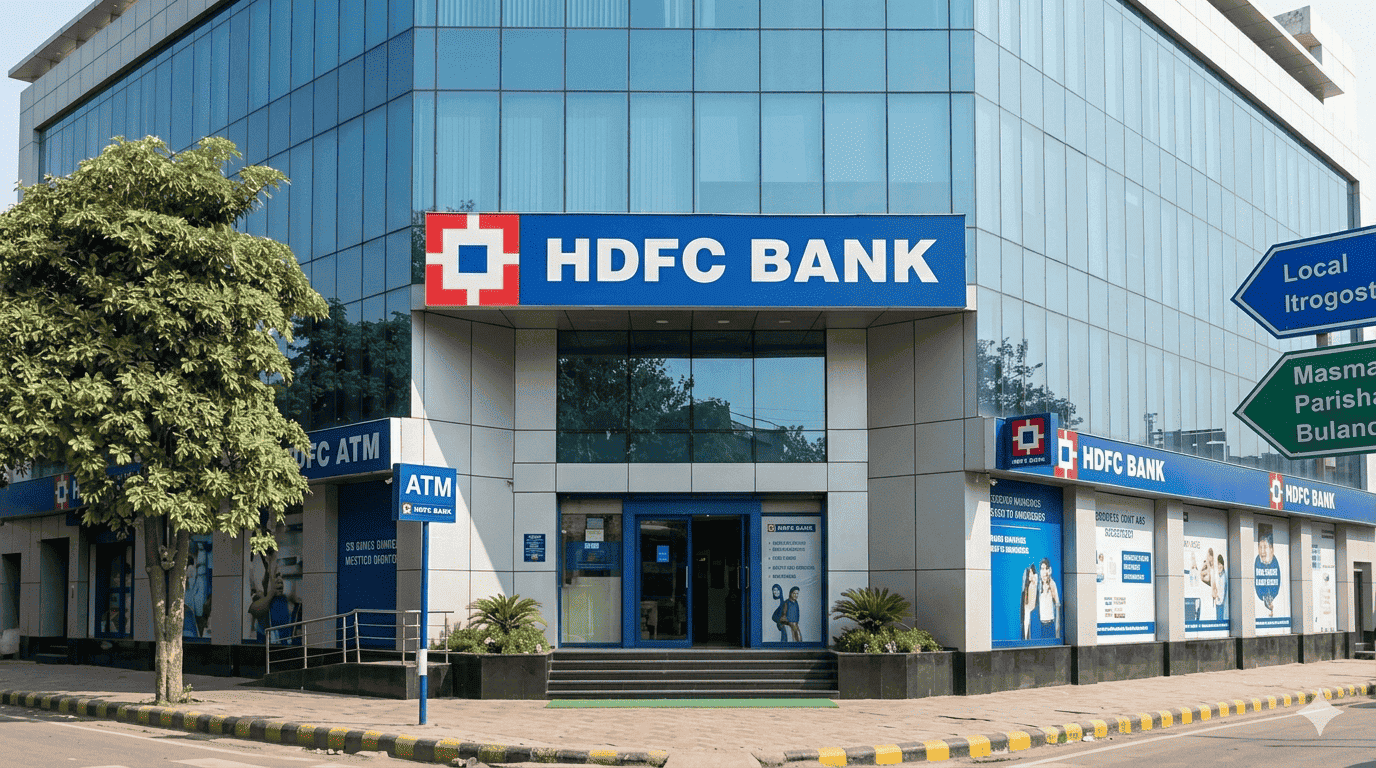
When HDFC Bank opened its first branch in Mumbai on January 16, 1995, it had one branch, one product, and a business plan that most of India’s banking establishment considered overly ambitious. Thirty-one years later, it is India’s largest private sector bank, with Rs 74,671 crore in standalone net profit for FY26, a balance sheet of Rs 43.6 lakh crore, 9,689 branches, and 101 million customers. It survived the demonetisation shock of 2016, a regulatory technology embargo in 2021, and the most complex bank merger in Indian corporate history on July 1, 2023, when it absorbed its parent company HDFC Ltd in a $40 billion all-stock deal. This is the complete story: who built it, how they built it, what the merger changed, and where it stands today.
Rs 74,671 Cr
Standalone net profit for FY26 (April 2025 to March 2026), up 10.9% from Rs 67,347 crore in FY25. Announced April 18, 2026. Consolidated PAT for FY26 was Rs 76,030 crore.
Rs 43.6 L Cr
Total standalone balance sheet size as of March 31, 2026. Up from Rs 39.1 lakh crore a year earlier. Gross advances: Rs 29.6 lakh crore. Deposits: Rs 31.05 lakh crore.
9,689
Branches as of March 31, 2026, across 4,170+ cities and towns. 51% in semi-urban and rural areas. Added 546 branches during FY26 alone.
101 Million
Customer base as of March 2026, up from 71 million in March 2022. GNPA at 1.15%. Capital adequacy ratio at 19.7% under Basel III. CET1 at 17.3%.
Table of Contents
- Part I: The Origins HDFC Ltd founded in 1977, banking liberalisation of 1992-93, HDFC Bank incorporated August 30, 1994, and the first branch in January 1995
- Part II: The Aditya Puri Era (1994 to 2020) 26 years of unbroken growth, the Times Bank merger, the CBoP acquisition, the retail lending revolution, and the making of India’s most valuable private bank
- Part III: Key Milestones and Inflection Points The 1995 IPO, internet banking in 1999, the 2008 CBoP merger, demonetisation in 2016, the RBI technology embargo, and the 2021 leadership transition
- Part IV: The Merger The $40 billion reverse merger with HDFC Ltd. April 2022 announcement, July 2023 completion, the 42:25 share swap, and what changed after the merger
- Part V: The Financials Annual and quarterly results from FY21 to FY26, balance sheet data, NIM, GNPA, CASA ratio, capital adequacy, and the cost-to-income story
- Part VI: The Group HDFC Life, HDFC AMC, HDFC ERGO, HDB Financial Services, and HDFC Securities. Stake percentages, business metrics, and group financials
- Part VII: The Business Model Retail banking, wholesale banking, treasury, digital banking, and how HDFC Bank earns its Rs 74,671 crore
- Frequently Asked Questions
Part IThe Origins
HDFC Ltd: The Parent That Came First
To understand HDFC Bank, you must first understand its parent. The Housing Development Finance Corporation Limited was incorporated in 1977, founded by Hasmukh Thakordas Parekh. Parekh was born on March 10, 1911, in Surat, Gujarat. He had studied at the London School of Economics and built a career in finance, eventually becoming Chairman and Managing Director of ICICI in 1972, from which he retired in 1976. At the age of 66, rather than retiring from public life, he founded HDFC Ltd with a single mission: to provide long-term mortgage finance to the growing middle class of India at a time when no institutional mechanism for home loans existed.
HDFC Ltd became India’s first specialised mortgage company. It was the dominant housing finance institution in India for over four decades. By the time of its merger into HDFC Bank in July 2023, it had a loan book of over Rs 7 lakh crore and had helped millions of Indian families finance their homes. Hasmukh Parekh passed away on November 18, 1994, just as HDFC Bank was being incorporated. His nephew Deepak Parekh succeeded him as Chairman of HDFC Ltd and stewarded the parent company until the merger.
Banking Liberalisation and the 1994 Licence
India’s banking sector was opened to private players by the Reserve Bank of India in 1993, following the economic liberalisation of 1991. The RBI invited applications for new private sector bank licences as part of the Narasimham Committee recommendations. Several groups applied. A handful received licences. HDFC Ltd was among them.
HDFC Bank Limited was incorporated on August 30, 1994, as a subsidiary of Housing Development Finance Corporation Limited. Its registered office was in Mumbai. The bank received its scheduled commercial bank licence from the RBI on the strength of HDFC Ltd’s capital strength, management track record, and the credibility of the HDFC brand among Indian households.
The bank commenced operations as a scheduled commercial bank in January 1995. The inaugural branch was opened in Mumbai. The bank’s very first managing director was Aditya Puri, who was recruited from Citibank Malaysia, where he had been heading operations. Puri remained the MD and CEO of HDFC Bank from its founding in 1994 until his retirement on October 26, 2020, a tenure of 26 unbroken years.
The first IPO in May 1995: Just months after commencing operations, HDFC Bank completed its initial public offering on the Bombay Stock Exchange in May 1995. This made it one of the fastest new banks in India to access public capital markets after inception. The IPO was priced at Rs 10 per share (face value Rs 10). The bank was listed and began building the retail investor ownership base that would eventually make it the most widely held private sector stock in India.
Part IIThe Aditya Puri Era (1994 to 2020)
Building the Bank From Scratch
Aditya Puri joined HDFC Bank as its founding Managing Director and CEO in 1994. He had spent the majority of his career at Citibank, working across India and Malaysia. He was 44 years old when he took charge at HDFC Bank. He would not leave for 26 years. In that period, he took a bank with one branch, no customers, and no brand recognition, and built it into India’s largest private sector financial institution by market capitalisation, loans, deposits, and profits.
Puri’s strategic vision was rooted in three convictions. First, that technology would define banking long before most Indian banks believed it. HDFC Bank invested in core banking technology from its earliest years, at a time when most public sector banks were still operating with manual ledgers. Second, that retail banking was the growth opportunity in liberalising India: millions of salaried professionals, small business owners, and middle-class households needed banking services that the PSU banks were not structured to deliver efficiently. Third, that risk management and asset quality were non-negotiable foundations. The bank would grow, but it would never sacrifice credit quality for growth.
The Times Bank Merger (2000)
HDFC Bank’s first major inorganic move was the merger with Times Bank Limited in February 2000. Times Bank had been promoted by Bennett Coleman and Company, the parent of The Times of India. It was a relatively small private bank with a modest customer base and technology platform. The merger was HDFC Bank’s first acquisition and brought it additional network strength in select markets. The Times Bank shareholders received 1 share of HDFC Bank for every 5.75 shares of Times Bank they held. The integration was completed smoothly, setting a template for how HDFC Bank would approach future acquisitions.
The Centurion Bank of Punjab Merger (2008)
The more significant acquisition was the merger with Centurion Bank of Punjab Limited (CBoP) in May 2008. CBoP had itself been formed through the earlier merger of Centurion Bank and Bank of Punjab in 2005. By the time of its acquisition by HDFC Bank, CBoP had 394 branches across India, a substantial presence in northern India where HDFC Bank’s network was thinner, and a well-regarded retail banking franchise.
The merger was completed through an all-stock deal. CBoP shareholders received 1 share of HDFC Bank for every 29 shares of CBoP. The acquisition added 394 branches, approximately 3.3 million customers, and over 7,500 employees to HDFC Bank’s network. It significantly deepened HDFC Bank’s presence in Punjab, Haryana, Rajasthan, and other northern states. The integration took two years to complete fully but was managed without material disruption to operations.
The Retail Banking Revolution
Under Puri, HDFC Bank pioneered several practices that became standard across Indian private sector banking. The salary account strategy was one of them. The bank aggressively signed corporate salary account relationships, which brought hundreds of thousands of employed individuals into the HDFC Bank ecosystem automatically each month. Once the salary account was established, the bank cross-sold personal loans, auto loans, credit cards, insurance, and wealth management products to the same customers, driving fee income and improving revenue per customer systematically.
By the time Puri retired in October 2020, HDFC Bank had net revenues of Rs 90,084 crore, net profit of Rs 31,116 crore, deposits of Rs 13.35 lakh crore, and advances of Rs 11.32 lakh crore. It was India’s second-largest bank by total assets, behind only the State Bank of India. Its market capitalisation had made it at various points the most valuable company listed on Indian exchanges.
26 years without a single annual net profit decline: One of the most extraordinary facts about Puri’s tenure is that HDFC Bank never posted a year-on-year decline in net profit for any single financial year under his leadership. From FY95 to FY21, profit grew every year without exception, through the dot-com bust, the 2008 global financial crisis, the 2012 NPA crisis in Indian banking, demonetisation in 2016, and the early COVID-19 period. No other major Indian bank has this record. This consistency was driven by the bank’s conservative provisioning culture, disciplined credit underwriting, and diversified revenue base.
Part IIIKey Milestones and Inflection Points
-
1994August 30, 1994HDFC Bank Incorporated
Incorporated as a subsidiary of HDFC Ltd in Mumbai. Receives RBI banking licence as part of the 1993 private sector banking liberalisation. Aditya Puri appointed founding MD and CEO. Operations commence at the Mumbai branch in January 1995.
-
1995May 1995IPO on BSE
HDFC Bank completes its IPO on the Bombay Stock Exchange within months of commencing operations. Issue price Rs 10 per share (face value Rs 10). The bank lists publicly, beginning the long journey to becoming India’s most widely held private sector stock.
-
19991999Internet Banking Launched
HDFC Bank launches internet banking in 1999, making it one of the first Indian banks to offer online banking. This early move into digital channels established the technology culture that would define the bank for the next two decades.
-
2000February 2000Times Bank Merger
HDFC Bank merges with Times Bank Limited, promoted by Bennett Coleman and Company. Swap ratio: 1 HDFC Bank share for every 5.75 Times Bank shares. HDFC Bank’s first acquisition; brings additional branch network and retail customers.
-
2008May 2008Centurion Bank of Punjab Merger
HDFC Bank acquires Centurion Bank of Punjab (CBoP) in an all-stock deal. Swap ratio: 1 HDFC Bank share for every 29 CBoP shares. Adds 394 branches, approximately 3.3 million customers, and deepens northern India presence significantly.
-
2016November 2016Demonetisation: A Moment of Strength
When the government demonetises Rs 500 and Rs 1,000 notes overnight on November 8, 2016, HDFC Bank’s ATM network, mobile banking, and branch infrastructure become critical. Cash deposits flood into the banking system. HDFC Bank’s digital and physical infrastructure handles the surge better than most peers, cementing its reputation as India’s most operationally reliable bank.
-
2021December 2020 to August 2021RBI Technology Embargo
RBI imposes a ban on HDFC Bank issuing new credit cards and launching new digital products, following repeated outages in the bank’s internet and mobile banking systems. The embargo lasts approximately eight months. It is one of the most significant regulatory actions against a private bank in India, costing the bank market share in the credit card segment it would take years to fully recover.
-
2020October 27, 2020Sashidhar Jagdishan Takes Charge
Sashidhar Jagdishan succeeds Aditya Puri as MD and CEO on October 27, 2020. Jagdishan had joined HDFC Bank in 1996 as a finance manager and rose through the ranks over 24 years. RBI subsequently extended his tenure to October 2026.
-
2022April 4, 2022Merger with HDFC Ltd Announced
HDFC Bank and HDFC Ltd announce a definitive agreement for HDFC Ltd to merge into HDFC Bank in an all-stock transaction valued at approximately $40 billion. It is the largest merger deal in Indian corporate history. The transaction is expected to close in 15 to 18 months.
-
2023July 1, 2023HDFC Ltd Merges into HDFC Bank
The merger becomes effective on July 1, 2023. Over 311 crore new HDFC Bank shares are allotted to HDFC Ltd shareholders on July 13, 2023 (Record Date), at the swap ratio of 42 HDFC Bank shares for every 25 HDFC Ltd shares. HDFC Bank becomes entirely publicly owned, with no promoter entity. India’s largest banking transaction is complete.
Part IVThe Merger
The $40 Billion Reverse Merger
On April 4, 2022, HDFC Bank and HDFC Ltd announced what would become the largest merger transaction in Indian corporate history. The deal was structured as a reverse merger: HDFC Bank, which was the subsidiary, would absorb HDFC Ltd, which was the parent. In a conventional merger, a parent absorbs a subsidiary. This transaction ran the other way, because HDFC Bank was by then significantly larger than HDFC Ltd by market capitalisation and had the banking licence and public deposit-taking capability that the combined entity needed as its primary vehicle.
The transaction was an all-stock deal. No cash changed hands. HDFC Ltd shareholders received 42 equity shares of HDFC Bank (face value Re 1) for every 25 equity shares of HDFC Ltd (face value Rs 2) they held. The record date for share allotment was July 13, 2023. Over 311 crore new HDFC Bank shares were allotted to HDFC Ltd shareholders. This diluted existing HDFC Bank shareholders and brought HDFC Ltd’s shareholders, who had previously owned a stake in the housing finance parent, into direct ownership of the bank.
| Merger Parameter | Detail |
|---|---|
| Announcement date | April 4, 2022 |
| Effective date | July 1, 2023 |
| Record date (share allotment) | July 13, 2023 |
| Transaction structure | All-stock reverse merger (HDFC Ltd absorbed into HDFC Bank) |
| Transaction value | Approximately $40 billion (largest merger in Indian corporate history) |
| Share swap ratio | 42 HDFC Bank shares for every 25 HDFC Ltd shares |
| New shares allotted | Over 311 crore HDFC Bank equity shares |
| HDFC Ltd stake in bank (pre-merger) | Approximately 21% |
| HDFC Ltd shareholders’ stake in merged entity | Approximately 41% |
| Promoter holding post-merger | Nil. HDFC Bank became 100% publicly owned with no promoter entity. |
| Regulatory approvals | RBI, NCLT, SEBI, Competition Commission of India, IRDAI, PFRDA |
| Scheme structure | First, HDFC Investments Ltd and HDFC Holdings Ltd (wholly-owned subsidiaries of HDFC Ltd) merged into HDFC Ltd; then HDFC Ltd merged into HDFC Bank. |
Why the Merger Happened
The strategic rationale for the merger was rooted in a changing regulatory environment. Over the decade leading up to 2022, the RBI had been progressively limiting the advantages available to non-bank finance companies (NBFCs) and housing finance companies (HFCs). Liquidity norms, capital adequacy requirements, and risk weight guidelines were being aligned closer to those applicable to banks. The regulatory gap that had historically allowed HDFC Ltd to operate with lower capital costs was narrowing.
At the same time, HDFC Bank had a structural limitation: it could not directly originate home loans on its balance sheet at HDFC Ltd’s scale without the mortgage expertise, processes, and customer relationships that HDFC Ltd had built over 45 years. The merger solved both problems simultaneously. HDFC Ltd shareholders gained access to lower-cost bank deposits. HDFC Bank gained the home loan franchise that HDFC Ltd had built. The combined entity could offer a seamless range of financial services, from savings accounts to home loans to insurance to mutual funds, through a single organisation with a single balance sheet.
What the merger meant for the balance sheet: Before the merger, HDFC Bank’s standalone total balance sheet was approximately Rs 22 lakh crore (March 2023). After the merger, incorporating HDFC Ltd’s loan book of over Rs 7 lakh crore and other assets, the combined balance sheet crossed Rs 31 lakh crore immediately on July 1, 2023. By March 2024, the post-merger balance sheet had reached Rs 36.2 lakh crore. By March 2026, it stood at Rs 43.6 lakh crore. The merger created a bank of a scale that no private sector competitor in India can match in the foreseeable future.
Post-Merger Challenges and Stabilisation
The merger created significant complexity in the near term. HDFC Ltd had been a wholesale-funded institution that raised money through bonds and commercial paper. HDFC Bank is a retail-deposit-funded institution. Integrating HDFC Ltd’s bond-funded mortgage book into a bank that relies on deposit funding required a deliberate and multi-year process of replacing wholesale borrowings with lower-cost retail deposits. This raised the bank’s cost of funds in the immediate post-merger period and compressed net interest margins.
In FY24 and FY25, HDFC Bank’s NIM compressed to approximately 3.44 to 3.46 percent from the 4.1 percent levels the bank had achieved before the merger. This compression was a source of investor concern and drove significant stock price underperformance relative to private sector banking peers in FY24. Management consistently guided that the margin compression was temporary and structural, driven entirely by the post-merger funding mix, and would recover as deposit mobilisation improved and the inherited wholesale borrowings matured and were replaced with deposits.
By Q4 FY26, NIM had stabilised at 3.38 percent on total assets and 3.53 percent on interest-earning assets. Gross advances grew 12 percent year-on-year to Rs 29.6 lakh crore. Deposits grew 14.4 percent to Rs 31.05 lakh crore. The deposit growth outpacing loan growth is a deliberate strategy to improve the loan-to-deposit ratio and reduce dependence on borrowings for funding.
Part VThe Financials
Annual Financial Performance: FY21 to FY26
| Year | Net Revenue (Rs Cr) | Net Profit Standalone (Rs Cr) | Net Profit Growth | Key Development |
|---|---|---|---|---|
| FY21 | 90,084 | 31,116 | 18.5% YoY | Final year under Aditya Puri. COVID-19 year. Consistent profit growth maintained despite pandemic. |
| FY22 | 1,09,600 (approx.) | 36,961 | 18.8% YoY | Post-COVID recovery. RBI technology embargo lifted in August 2021. Credit card growth resumes. |
| FY23 | 1,31,340 (approx.) | 44,109 | 19.3% YoY | Strong pre-merger organic growth. Merger announced April 2022. Advances and deposits grow in mid-teens. |
| FY24 | 1,89,124 | 60,812 | 37.9% YoY | Merger effective July 1, 2023. First full half-year as merged entity. Revenue jumps due to HDFC Ltd integration. NIM compression begins. |
| FY25 | 1,68,300 | 67,347 | 10.7% YoY | Post-merger normalisation. NIM stabilisation underway. Deposit mobilisation strategy in full force. GNPA improved to 1.33%. |
| FY26 | 1,91,220 | 74,671 | 10.9% YoY | First full year of stable post-merger operations. Deposits grew 14.4%. Advances grew 12%. GNPA improved to 1.15%. Board approved Rs 60,000 crore fundraise. |
Standalone Net Profit: FY21 to FY26 (Rs Crore)
Source: HDFC Bank BSE filings and investor presentations. FY24 net profit includes merger integration effects. All figures standalone Indian GAAP.
Balance Sheet and Key Ratios: FY26
Total Balance Sheet (Standalone)
Rs 43,64,886 Cr
As of March 31, 2026. Up from Rs 39,10,199 crore a year earlier.
Gross Advances
Rs 29,60,000 Cr
Up 12% YoY from Rs 26,43,500 crore in March 2025. Retail 53%, SME 21%, Corporate 26%.
Total Deposits
Rs 31,05,500 Cr
Up 14.4% YoY from Rs 27,14,700 crore in March 2025. CASA Rs 10,60,500 crore (34% ratio).
Net Interest Margin (NIM)
3.38%
On total assets in Q4 FY26. 3.53% on interest-earning assets. Stabilising post-merger.
Gross NPA
1.15%
As of March 31, 2026. Improved from 1.33% in March 2025 and 1.42% in December 2024.
Capital Adequacy Ratio
19.7%
Under Basel III as of March 2026. CET1 at 17.3%. Regulatory minimum: 11.9%. Well above requirement.
Return on Assets (RoA)
1.96%
Q4 FY26. Return on Equity (RoE) at 14.1% for the quarter.
Cost-to-Income Ratio
39.9%
Q4 FY26. Down from 40.6% in Q3 FY25. Among the best in Indian private sector banking.
EPS (Book Value/Share)
Rs 2,012
Book value per share as of March 2026 (per Q4 FY26 Earnings Presentation). FY26 EPS (standalone): approximately Rs 97.6 per share.
Quarterly Performance: FY26
| Quarter | Net Revenue (Rs Cr) | NII (Rs Cr) | Net Profit (Rs Cr) | GNPA (%) | Notable |
|---|---|---|---|---|---|
| Q1 FY26 (Apr-Jun 2025) | 42,836 | 31,395 | 16,175 | 1.33% | Deposit growth momentum continues. Advance growth steady. |
| Q2 FY26 (Jul-Sep 2025) | 44,527 | 32,527 | 20,611 (approx.) | 1.27% | GNPA improves. Deposit growth outpaces loan growth. CASA stable at 34%. |
| Q3 FY26 (Oct-Dec 2025) | 45,870 | 32,620 | 18,664 | 1.24% | Net profit up 11.46% YoY. Total income Rs 90,005 crore. GNPA improves sequentially. |
| Q4 FY26 (Jan-Mar 2026) | 46,280 | 33,080 | 19,221 | 1.15% | Net profit up 9.1% YoY. NIM 3.38%. Balance sheet crosses Rs 43.6 lakh crore. Board approves Rs 60,000 crore fundraise. Dividend of Rs 13/share recommended. |
FY26 full year summary: Standalone net profit of Rs 74,671 crore, up 10.9% from Rs 67,347 crore in FY25. Net revenue of Rs 1,91,220 crore, up 13.6% from Rs 1,68,300 crore. Balance sheet at Rs 43.64 lakh crore. Gross advances Rs 29.6 lakh crore (up 12% YoY). Deposits Rs 31.05 lakh crore (up 14.4% YoY). GNPA improved to 1.15% from 1.33% a year earlier. CET1 at 17.3%. Total FY26 dividend: Rs 15.50 per share (Rs 2.50 special interim paid August 2025, plus Rs 13.00 final subject to AGM approval). Consolidated PAT for FY26: Rs 76,030 crore.
Part VIThe Group
Five Major Subsidiaries That Make HDFC a Financial Conglomerate
HDFC Bank is not just a bank. Through its five principal subsidiaries, the HDFC Group spans life insurance, general insurance, asset management, non-banking finance, and stock broking. Each subsidiary has a meaningful independent scale and contributes to the consolidated financial profile. The consolidated PAT for FY26 was Rs 76,030 crore, versus the standalone Rs 74,671 crore, with the difference reflecting subsidiary contributions net of intercompany eliminations.
HDFC Life Insurance Company Ltd
Bank stake: 50.21% as of March 2026
Listed life insurer. Individual weighted received premium market share of 15.2% for FY26. Premium earned Rs 264 billion in Q4 FY26, up 10% YoY. AUM at Rs 3.8 trillion up 12% YoY. New Business Margin at 24%. Embedded value Rs 621 billion up 12% YoY. Solvency ratio 177%. PAT for Q4 FY26: Rs 5.0 billion, up 4% YoY.
HDFC Asset Management Company Ltd (HDFC AMC)
Bank stake: 52.37% as of March 2026
Listed mutual fund manager. Quarterly average AUM of Rs 9.3 trillion in Q4 FY26. Market share of 11.4% in the mutual fund industry. 65% of quarterly average AUM is equity-oriented with 61% in actively managed equity funds. One of the two largest mutual fund managers in India by AUM.
HDFC ERGO General Insurance Company Ltd
Bank stake: 50.3% as of March 2026
General insurance subsidiary offering motor, health, home, travel, and commercial insurance. Net profit for Q4 FY26: Rs 1.6 billion (vs Rs 0.7 billion in Q4 FY25, up 129% YoY). Solvency ratio 207%. Covers a wide range of retail and corporate general insurance products distributed through HDFC Bank’s branch network and independent channels.
HDB Financial Services Ltd (HDBFSL)
Bank stake: 74.12% as of March 2026
Non-deposit taking NBFC. Listed on Indian exchanges after its IPO. Loan book of Rs 1,185 billion (Rs 1.185 lakh crore) as of March 2026, up 10.9% YoY. 22.9 million customers. 1,730 branches across 1,161 cities and towns. Net profit Q4 FY26: Rs 7.5 billion, up 41% YoY and 17% QoQ. NIM at 8.2%.
HDFC Securities Ltd (HSL)
Bank stake: 94.0% as of March 2026
One of India’s leading stockbroking firms. Serves retail and institutional clients. Net profit for Q4 FY26: Rs 2.7 billion, up 6.8% YoY. EPS Rs 150.3. Provides equity, commodity, currency, and derivative trading services. Distributed through HDFC Bank’s customer base and independently through digital channels.
Part VIIThe Business Model
How HDFC Bank Earns Its Money
HDFC Bank operates a universal banking model. Revenue comes from two primary sources: net interest income (the spread between what the bank earns on loans and what it pays on deposits) and non-interest income (fees, commissions, trading income, and other service charges). In FY26, NII represented approximately 71 percent of net revenue, with non-interest income contributing approximately 29 percent. The bank’s four main operating segments are retail banking, wholesale banking, treasury, and digital banking (reported as a sub-segment of retail banking).
Retail banking is HDFC Bank’s core engine. It covers savings accounts, current accounts, fixed deposits, personal loans, auto loans, home loans (significantly expanded after the HDFC Ltd merger), credit cards, debit cards, two-wheeler loans, consumer durable loans, and rural banking products. Retail loans represent approximately 53 percent of the total loan book as of March 2026, having grown 9 percent year-on-year in FY25.
HDFC Bank has 101 million customers as of March 2026, up from 71 million in March 2022. The salary account strategy, where the bank signs corporate agreements to handle employee salary payments, brings millions of new-to-bank customers into the system at very low acquisition cost. These customers are then systematically cross-sold into credit products, insurance, and investment products, generating fee income per customer that is among the highest in Indian banking.
The credit card franchise is one of HDFC Bank’s key competitive positions. Despite the eight-month embargo imposed by the RBI in late 2020, HDFC Bank rebuilt its credit card market share and remains among the top issuers in India by outstanding balances. Credit card interest income and transaction fees are high-margin contributions to the non-interest income line.
Wholesale banking serves corporate clients, multinational corporations, financial institutions, and the government. It provides working capital loans, term loans, trade finance, cash management, foreign exchange, and debt capital market services. Corporate and wholesale loans represent approximately 26 percent of the total loan book as of March 2026. This segment was deliberately slowed down in the post-merger period, with corporate loans declining approximately 3.6 percent year-on-year in FY25, as the bank focused on improving credit quality and reducing concentration risk in the corporate book.
The wholesale banking division is a significant contributor to fee income. Trade finance fees, loan processing fees, treasury transactions for corporate clients, and cash management fees collectively generate substantial non-interest income. The government banking business, which handles direct benefit transfer flows, tax collections, and state government payments, is a large and stable fee income contributor.
Commercial and rural banking covers small and medium enterprises, agribusiness loans, Kisan credit cards, tractor loans, gold loans, self-help group financing, and microfinance. This segment has been one of the fastest-growing parts of the book in recent years. Commercial and rural loans grew approximately 12.8 percent year-on-year in FY25, outpacing both retail and corporate segments.
The rural focus is tied directly to the bank’s branch strategy. Over 51 percent of HDFC Bank’s 9,689 branches as of March 2026 are located in semi-urban and rural areas. The bank has historically been criticised for concentrating its network in metropolitan areas, and the deliberate push toward semi-urban and rural branches under Sashidhar Jagdishan has been a defining strategic shift of the post-2020 period. These branches are essential for deposit mobilisation at lower cost and for serving the agricultural and MSME credit demand that the RBI and the government have consistently prioritised.
The treasury segment manages the bank’s investment portfolio (government securities, bonds, and equity), foreign exchange operations, and derivatives. Treasury income can be volatile, as it is influenced by interest rate movements and bond market conditions. In FY25 and FY26, treasury contributed a stable share of other income, with the Q4 FY26 other income of Rs 13,200 crore supported by fee income of Rs 9,220 crore alongside treasury and miscellaneous income.
Digital banking has been a priority under Jagdishan’s leadership. The bank launched the PayZapp 2.0 mobile platform, SmartHub Vyapar for small merchants, and integrated Unified Payments Interface (UPI) deeply into its retail and corporate platforms. HDFC Bank processes billions of UPI transactions monthly and uses digital banking data to identify cross-selling opportunities, assess creditworthiness for instant personal loans, and serve customers without physical branch visits. The bank’s digital banking investments are tracked as a sub-segment of retail banking in its reporting.
Thirty-One Years. One Private Bank. India’s Biggest.
HDFC Bank was created because Indian banking needed competition. In 1994, the banking system was dominated by public sector institutions that were slow, bureaucratic, and not oriented toward retail customers. HDFC Bank and a handful of other new private sector banks changed that. Of all of them, HDFC Bank changed it the most completely.
The Aditya Puri era from 1994 to 2020 produced a record that may never be equalled in Indian banking. Twenty-six consecutive years of growing profits, through economic downturns, political disruptions, regulatory challenges, and a global pandemic. The bank that Puri handed over to Sashidhar Jagdishan in October 2020 was already the most valuable private company in India by market capitalisation.
Jagdishan’s era has been defined by the merger. The absorption of HDFC Ltd in July 2023 created a bank of a scale that has no peer in the Indian private sector. A Rs 43.6 lakh crore balance sheet. Rs 31 lakh crore in deposits. Rs 29.6 lakh crore in advances. A customer base of 101 million. The merger came with transition costs: NIM compression, a higher cost of funds, deposit mobilisation pressure, and the operational complexity of integrating over 4,000 HDFC Ltd employees and a mortgage book of Rs 7 lakh crore into a banking system. The FY26 results suggest that most of these transition effects have been absorbed. GNPA is at its best level in years. Deposits are growing faster than advances. The cost-to-income ratio is improving.
The questions ahead are about the second decade of Jagdishan’s leadership and the structural potential of the merged entity. A bank with 101 million customers in a country where financial inclusion is still deepening, and where mortgage penetration at 13 percent of GDP is among the lowest of any major emerging economy, has an unusually large addressable market for the next two decades of growth.
Frequently Asked Questions
HDFC Bank Limited was incorporated on August 30, 1994, as a subsidiary of Housing Development Finance Corporation Limited (HDFC Ltd.) in Mumbai. HDFC Ltd. was itself founded in 1977 by Hasmukh Thakordas Parekh, who was born on March 10, 1911 in Surat, Gujarat, and passed away on November 18, 1994. HDFC Bank was incorporated in the same year of his passing. The bank’s founding Managing Director and CEO was Aditya Puri, who was recruited from Citibank Malaysia and who led the bank for 26 years until his retirement on October 26, 2020. The bank received its RBI licence as part of the 1993 private sector banking liberalisation, commenced operations as a scheduled commercial bank in January 1995, and completed its IPO on the Bombay Stock Exchange in May 1995.
On April 4, 2022, HDFC Bank and its parent company HDFC Ltd announced a definitive agreement for HDFC Ltd to merge into HDFC Bank in an all-stock transaction valued at approximately $40 billion. It was the largest merger deal in Indian corporate history. The deal was structured as a reverse merger: HDFC Bank (the subsidiary) absorbed HDFC Ltd (the parent). The merger became effective on July 1, 2023. HDFC Ltd shareholders received 42 equity shares of HDFC Bank for every 25 equity shares of HDFC Ltd they held on the record date of July 13, 2023. Over 311 crore new HDFC Bank shares were allotted. Following the merger, HDFC Bank became 100 percent publicly owned with no promoter entity. HDFC Ltd shareholders held approximately 41 percent of the merged bank. The merger brought HDFC Ltd’s mortgage book of over Rs 7 lakh crore, its customer relationships, and its housing finance expertise into the banking structure, allowing the combined entity to serve customers with a full range of financial products from a single platform.
HDFC Bank announced its FY26 (April 2025 to March 2026) results on April 18, 2026. On a standalone basis, net revenue for the full year was Rs 1,91,220 crore, up 13.6 percent from Rs 1,68,300 crore in FY25. Standalone net profit (PAT) was Rs 74,671 crore, up 10.9 percent from Rs 67,347 crore in FY25. For Q4 FY26 specifically, standalone net profit was Rs 19,221 crore, up 9.1 percent year-on-year from Rs 17,616 crore in Q4 FY25. Net interest income in Q4 FY26 was Rs 33,080 crore, up 3.2 percent. Net interest margin was 3.38 percent on total assets. Gross NPA improved to 1.15 percent from 1.33 percent a year earlier. Total balance sheet size reached Rs 43,64,886 crore. Gross advances were Rs 29.6 lakh crore, up 12 percent year-on-year. Deposits were Rs 31.05 lakh crore, up 14.4 percent. On a consolidated basis, PAT for FY26 was Rs 76,030 crore. The board recommended a final dividend of Rs 13 per share for FY26, taking the total FY26 dividend to Rs 15.50 per share including the Rs 2.50 special interim dividend paid in August 2025.
HDFC Bank has five major subsidiaries as of March 2026. HDFC Life Insurance Company Ltd (50.21% stake), a listed life insurer with AUM of Rs 3.8 trillion and an individual weighted received premium market share of 15.2 percent in FY26. HDFC Asset Management Company Ltd (52.37% stake), a listed mutual fund manager with quarterly average AUM of Rs 9.3 trillion and 11.4 percent market share in the mutual fund industry. HDFC ERGO General Insurance Company Ltd (50.3% stake), a general insurance subsidiary offering motor, health, home, and commercial insurance products. HDB Financial Services Ltd (74.12% stake), a listed non-deposit taking NBFC with a loan book of Rs 1.185 lakh crore, 22.9 million customers, and 1,730 branches. HDFC Securities Ltd (94.0% stake), one of India’s leading stockbroking firms. Consolidated net revenue for FY26 was Rs 3,09,970 crore and consolidated PAT was Rs 76,030 crore, with subsidiary contributions adding to the standalone bank performance.
Sashidhar Jagdishan is the Managing Director and Chief Executive Officer of HDFC Bank. He took charge on October 27, 2020, succeeding Aditya Puri, who had led the bank since its founding in 1994. Jagdishan joined HDFC Bank in 1996 as a manager in the finance function. He became Business Head of Finance in 1999, Chief Financial Officer in 2008, and Group Head overseeing finance, human resources, legal, administration, and infrastructure before being appointed MD and CEO. The RBI approved his appointment initially for three years and subsequently extended his tenure to October 26, 2026. He has overseen the most complex period in the bank’s history, navigating the RBI technology embargo, the post-COVID recovery, and the landmark merger with HDFC Ltd in July 2023. He has also led a deliberate expansion of the branch network into semi-urban and rural markets, with over 51 percent of the bank’s 9,689 branches now in non-metro locations.
In December 2020, the Reserve Bank of India directed HDFC Bank to temporarily stop all new credit card issuances and all planned digital product launches. The action followed a series of outages in HDFC Bank’s internet and mobile banking systems, including a significant breakdown on November 21, 2020, which disrupted services for a large number of customers. This was part of a pattern of technology reliability issues the bank had experienced over the prior two years. The embargo applied to new credit card sourcing and new digital initiatives. Existing credit cards continued to function normally, and the ban did not affect deposit-taking, lending, or branch operations. The RBI lifted the restrictions in August 2021, approximately eight months after they were imposed. The period of the embargo cost HDFC Bank significant market share in new credit card issuances, a category where it had been the dominant player. Competitors SBI Card and ICICI Bank gained share during this period. HDFC Bank rebuilt its credit card portfolio after the embargo was lifted and remains among the largest credit card issuers in India, though recovering the full pre-embargo position took several years.
Disclaimer: This article is for informational and educational purposes only and is current as of June 2026. All figures are standalone Indian GAAP unless noted as consolidated. This article does not constitute investment advice or a recommendation to buy or sell any security. Readers should consult a SEBI-registered investment adviser before making investment decisions. fiscalzenith.com accepts no liability for decisions made in reliance on information in this article.